How to upgrade vCenter server appliance

Prior to VMware vCenter Server Appliance 6.x, upgrading or patching vCSA was as simple as a few button clicks in the appliance UI. Gone are those days, as VMware has replaced the appliance UI with a DCUI and the web based install wizard during setup.

The good news is, upgrading or patching the vCSA 6.x is still pretty simple via the command line!

How to patch or upgrade VMware vCenter 6.x Appliance

  1. Download the vCSA .ISO patch from VMware.
  2. Upload the ISO to a datastore the vCSA has access to and mount the ISO to the vCSA virtual machine.
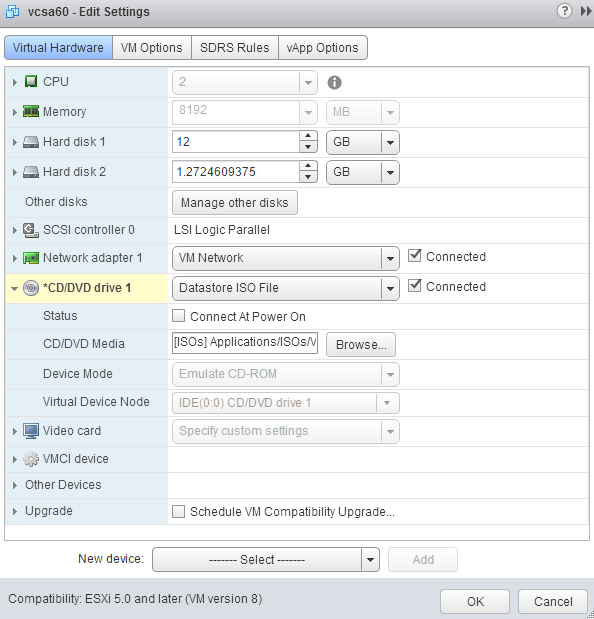
    VMware vCSA mount ISO
  3. Connect to the vCSA via SSH using PuTTy or your choice of client.
  4. Type the following command:
    software-packages install --iso --acceptEulas
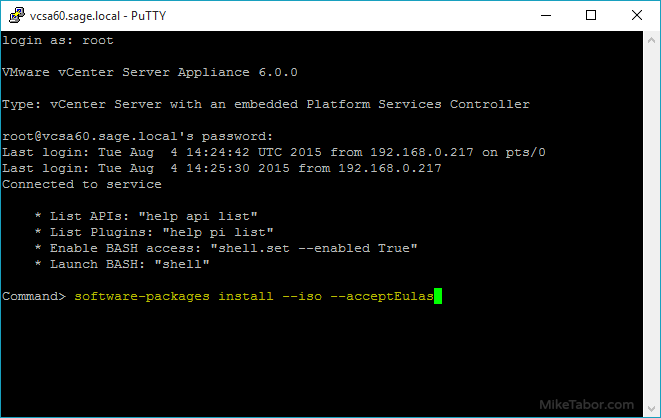
    VMware vCSA upgrade command

  5. After just a minute or two the update will complete, now reboot the appliance by typing the following command:
    shutdown reboot -r updating

    VMware vCSA reboot command

And that’s it, sure it’s not the old (5.x) appliance UI but still pretty darn easy to update your VMware vCenter Server Appliance with the latest build.
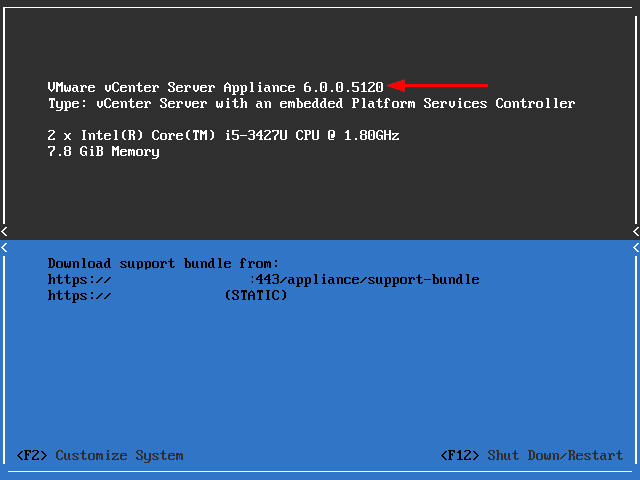
VMware vCSA updated

Similar Posts

  • VMware Site Recovery Manager 8.2 – No more Windows

    VMware has just announced the release of Site Recovery Manager 8.2. There are a number of new items in SRM 8.2, such as enhancements to the HTML5 user interface, support for vSphere 6.7 Update 2, but most notably is Site Recovery Manager 8.2 virtual appliance!

    No more Microsoft Windows license needed! The SRM 8.2 virtual appliance runs on the Photon OS distro, which is similar to what the vCenter virtual appliance has been running on for years now.

    Read More “VMware Site Recovery Manager 8.2 – No more Windows”

  • Easy ESXi 5.5 upgrade via command line

    ESXi 5.5 was just released general availability (GA) on Sunday (9/22) and I’m itching to upgrade the home lab to run the latest version with all it’s goodies. I wanted to try upgrading my hosts without having to go through the same process that I followed setting up ESXi on the NUC in the first place, injecting custom NIC drivers, etc.

    Enter the command line…

    1. Move all VM’s from the host and then put the host into Maintenance Mode.
    2. Go to the Configuration tab > Security Profile and Enable SSH under Services.
      ssh enabled
    3. Under Firewall, enable httpClient (outbound http).
      httpClient enable
    4. Open PuTTY (or other SSH client) and SSH into your host.
    5. Read More “Easy ESXi 5.5 upgrade via command line”

  • VMware Recertification Policy

    VMware certified

    Starting today, March 10 2014, new VCP certifications must be re-certified within two years of it’s earned date. Anyone who currently has their VCP certification prior to March 10 2013 has until March 10, 2015 to re-certify.

    The new policy gives you three options to re-certify:

    1. Take the current exam for your existing VCP certification solution track. For example, if you are a VCP3, you could take the current VCP5-Data Center Virtualization (VCP5-DCV) exam.
    2. Earn a new VCP certification in a different solution track. For example, if you are a VCP-Cloud, you could recertify by earning VCP5-Desktop (VCP5-DT) certification.
    3. Advance to the next level by earning a VMware Certified Advanced Professional (VCAP) certification. For example, if you are a VCP5-DCV you could earn VCAP5-DCA certification.

    I can understand why they are doing this but I don’t agree with the changes. As per the announcement if you let your certification expire, “Your certification will be revoked,and you will no longer be entitled to use the certification logo or represent yourself as VMware certified“. Really? You mean everything that was done prior and after taking the exam means nothing?

    Read More “VMware Recertification Policy”

  • Fix VMware VCSA /storage/log filesystem out of disk space

    This morning I ran into an issue where users were reporting the production VCSA 6.0 was not allowing them to connect into the web or thick client. Another administrator rebooted the VCSA which seemed to work only briefly. I then logged into the VCSA web management (https://<VCENTER_IP>:5480) and noticed the following health status right away:

    The /storage/log filesystem is out of disk space or inodes

    vcsa /storage/log full

    Read More “Fix VMware VCSA /storage/log filesystem out of disk space”

  • Increase incremental backup speed by enabling CBT

    In a recent VMware environment I was working in, we noticed that our incremental backups was taking a long time (like up to 7-8 hours) to complete. After digging around it was found that VMware actually has a feature built-in since version 4 called Change Block Tracking (CBT). CBT will track any blocks that were changed since the last backup and tag them and stores the information in a -CTK file. The obvious benefit is that now the third party software only backs up the changed block and not the entire VM each time, reducing the amount of data being backed thus speeding up backups and even lowers the CPU utilization on the VM host.

    CBT is disabled by default though there are some backup tools that will enable it automatically or you can enable it manually which can easily be done following these steps:

    Read More “Increase incremental backup speed by enabling CBT”

  • Update vCenter Server Appliance 6.7 to 6.7 Update 1

    VMware has released vCenter Server 6.7 Update 1 and with comes with a number changes.

    One most notable change is the feature complete HTML5 vSphere client. The vSphere client in vCenter 6.7 Update 1 now includes the ability to manage:

    • Host profiles
    • Auto deploy
    • Full vSphere Update Manager (VUM)
    • A new dark theme
    • and vCenter High Availability.

    That’s no where near all of the changes though, there are many more changes and updates in the 6.7 Update 1 update. Be sure to read the full release notes here.

    In this post we’ll see just how easy it is to upgrade from VCSA 6.7 to VCSA 6.7 Update 1 in just a couple steps!

    Read More “Update vCenter Server Appliance 6.7 to 6.7 Update 1”

Leave a Reply

Your email address will not be published. Required fields are marked *

2 Comments

  1. Any idea why there are so many partitions on the 6.x appliance? I count 11 disks. The 5.5 appliance has 2 disks.