Upgrade ESXi host to ESXi 5.5 using VMware Update Manager 5.5

A while back I wrote about how to upgrade to ESXi 5.5 via command line which works great when you only have a few hosts as each host has to download the ISO from the web each time. This time I’ll show you step by step how to upgrade your ESXi 5.1 host to ESXi 5.5 using VMware Update Manager 5.5 (aka VUM).

For this post I’m going to assume you have already upgraded your vCenter and VUM to versions 5.5 as well as the VUM plugin installed. So lets begin!

Upgrade ESXi host to 5.5 using VMware Update Manager (VUM)

  1. Open the vSphere client and click on Update Manager
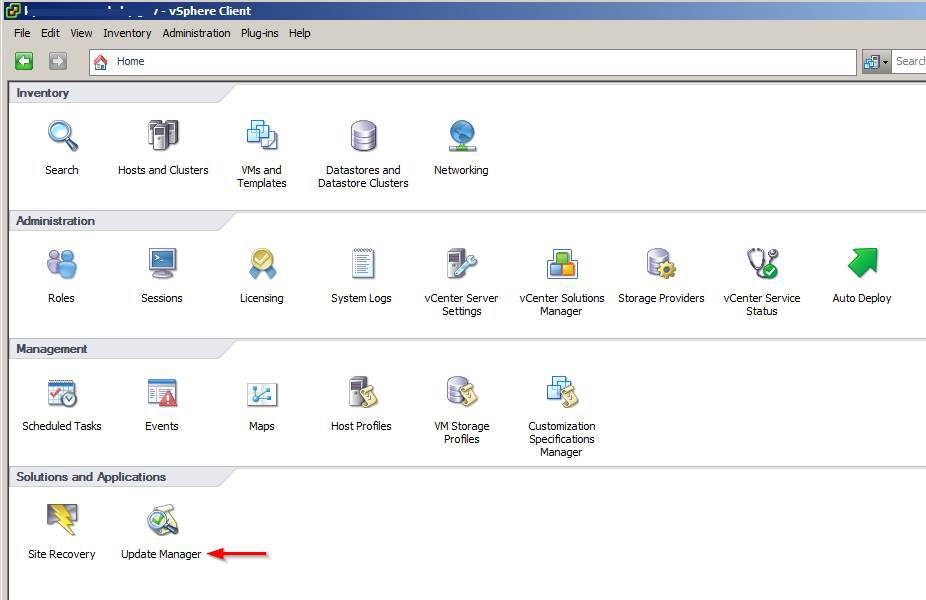
    VMware Update Manager icon

  1. First we’ll upload the ISO image. Click on the “ESXi Images” tab.
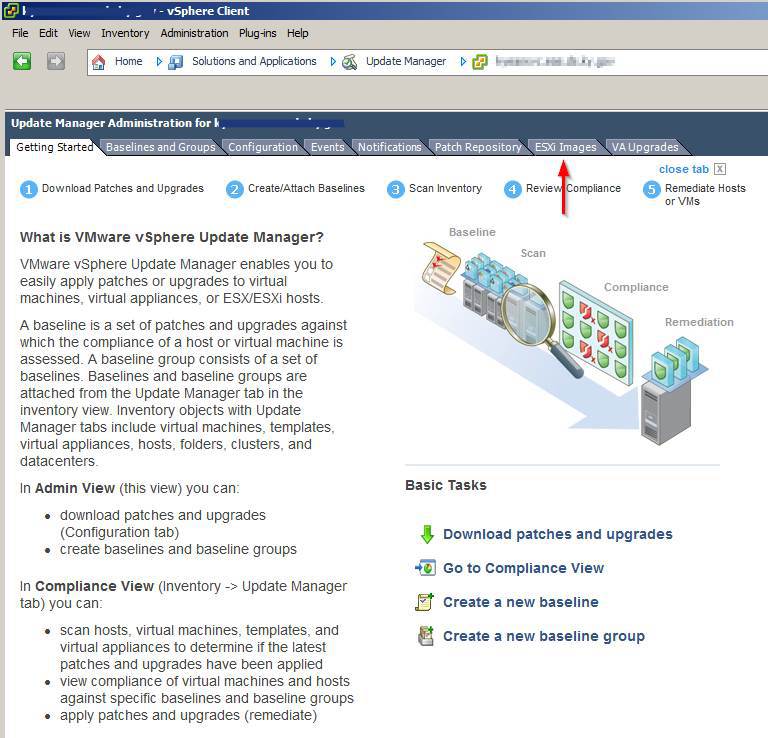
    vum esxi image tab
  2. Click on the “Import ESXi Image” link.
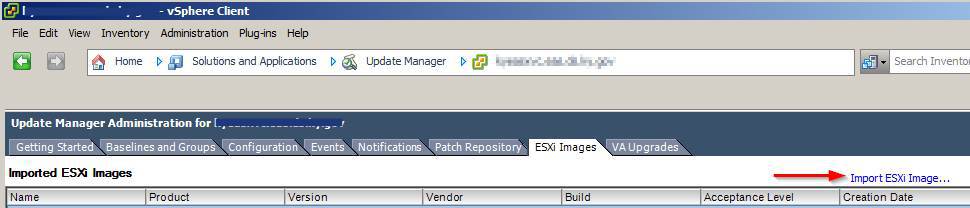
    import-esxi-image
  3. Click on “Browse” and select the path where the ESXi 5.5 ISO image is located on your machine or network, then click “Next“.
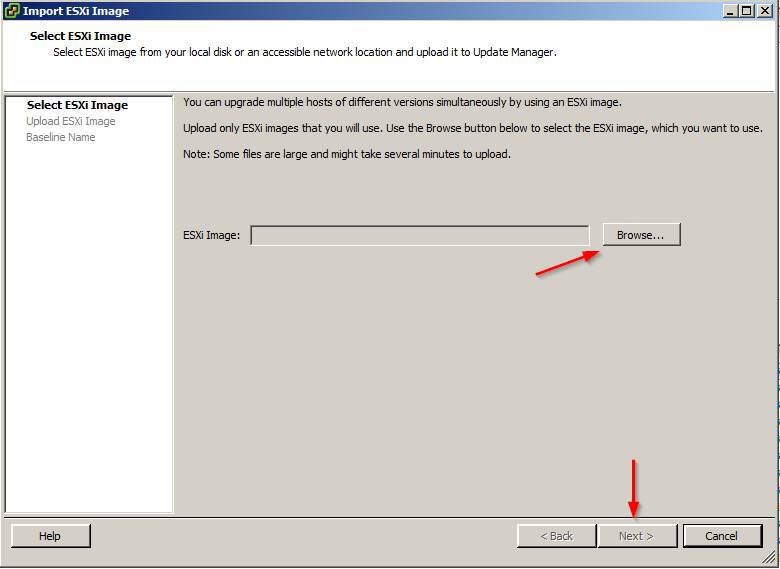
    browse-iso-location
  4. The ISO image will then start the process of upload the image. This typically just takes a minute or two.
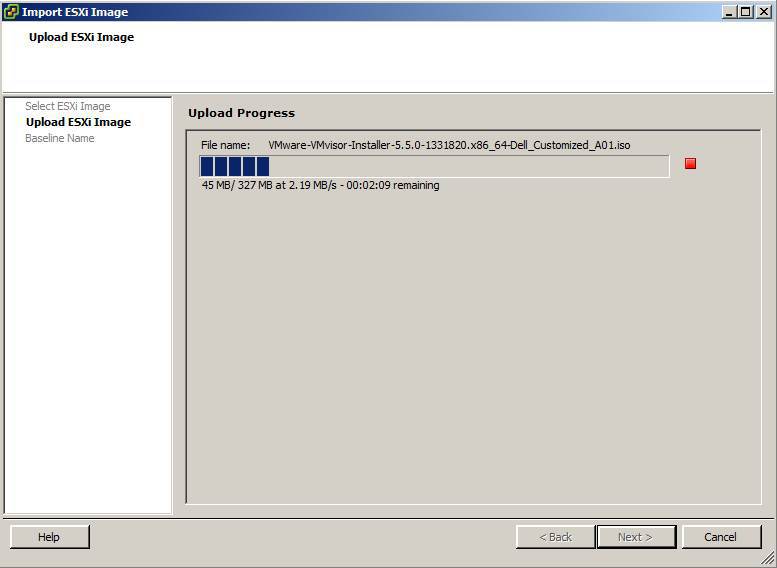
    iso-upload
  5. After the ESXi 5.5 ISO image upload is completed you are prompted to create a baseline. Go ahead and do so as we’ll need a baseline in order to upgrade the hosts anyways. Simply enter a name and description for the Baseline.
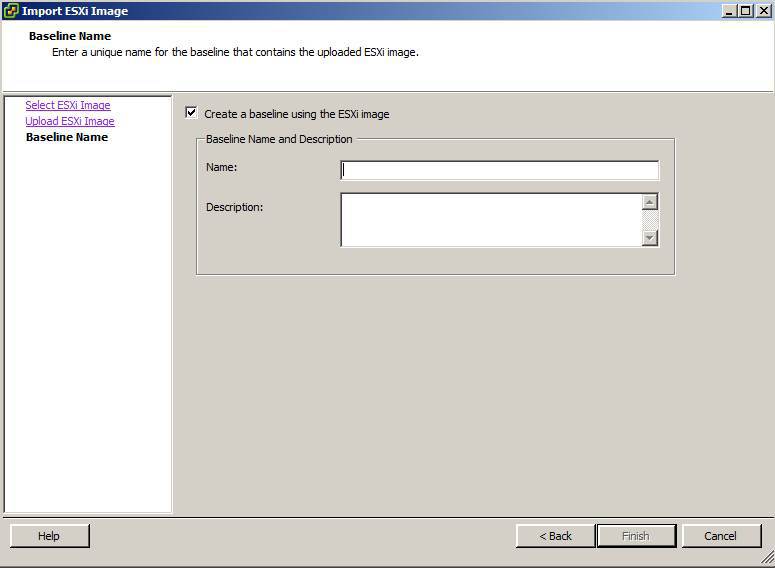
    create-baseline
  6. Go to the Hosts and Clusters view and select the host you want to upgrade first and then select the “Update Manager” tab, then click on the “Attach” link so that we can attach our new Baseline to this host.

    host-update-tab
  7. Now select the newly created Baseline you created during the upgrade, then click on “Attach“. In this example, since this is a Dell host I named the baseline “Dell 5.5 Hosts”.
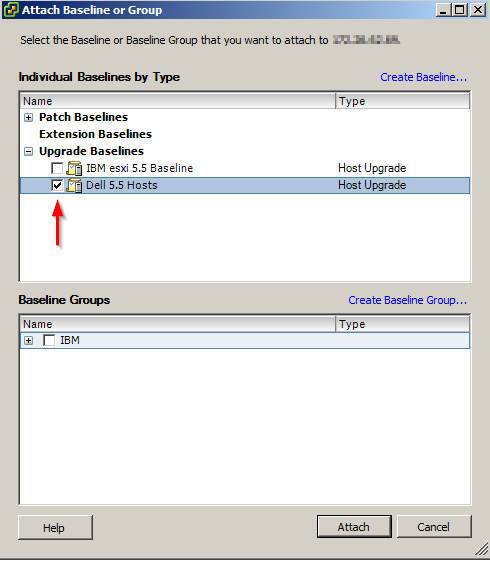
    select-baseline
  8. Once you have attached the baseline now click on “Scan“.
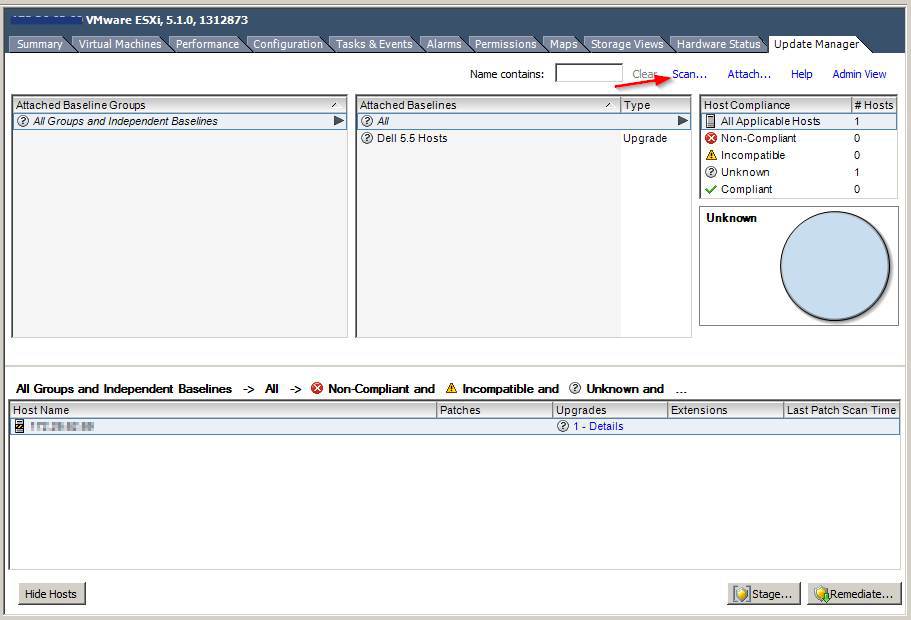
    scan-host
  9. In the scan confirmation window make sure that “Upgrades” are checked and then click on “Scan“. This step can take several minutes.
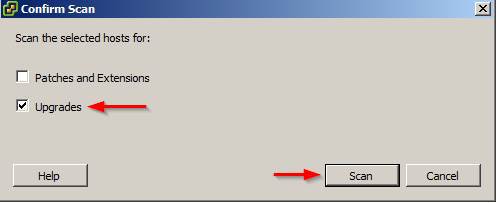
    confirm-scan
  10. When the scan is complete you’ll be shown the results such as below which will tell you the host (ESXi 5.1) is not compliant with the baseline (ESXi 5.5). To remedy this click on “Remediate“.
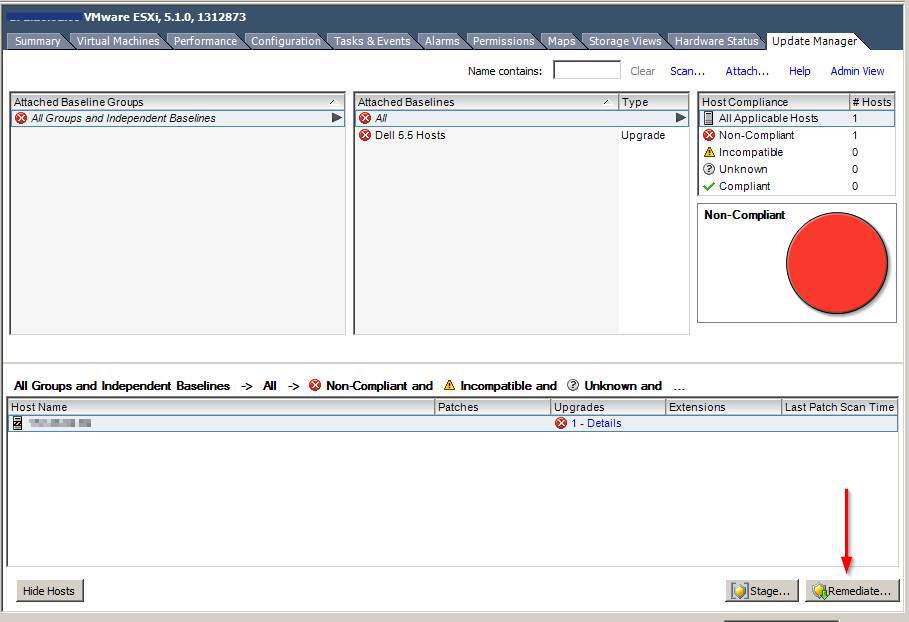
    remediate
  11. Select your baseline and click on “Next“. Agree to the EULA terms and click “Next“.
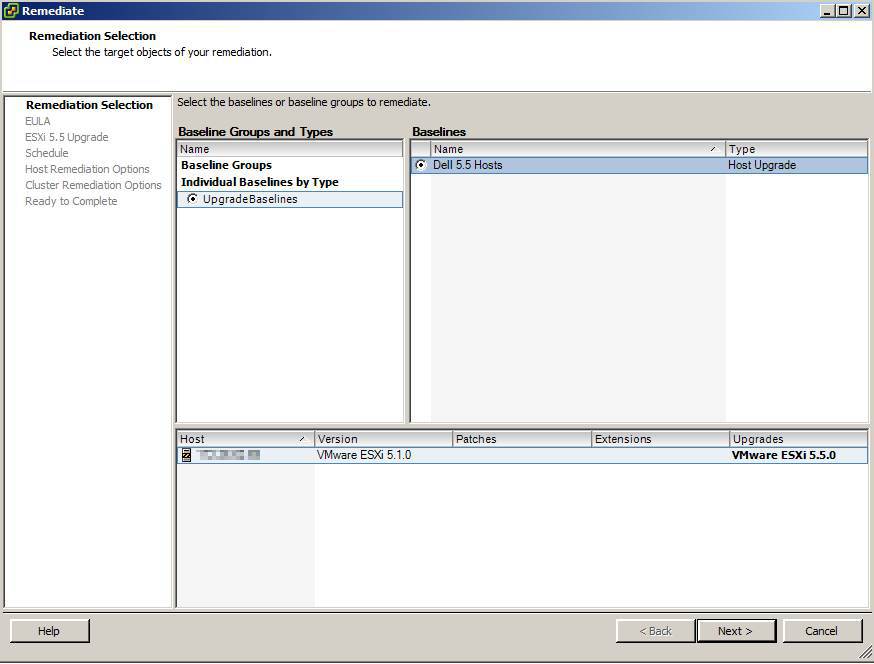
    remediate-selection
  12. Give the task a name and if you want, at this step you could schedule the upgrade for anytime. We’ll go ahead and leave the default setting and run it immediately. Click “Next“.
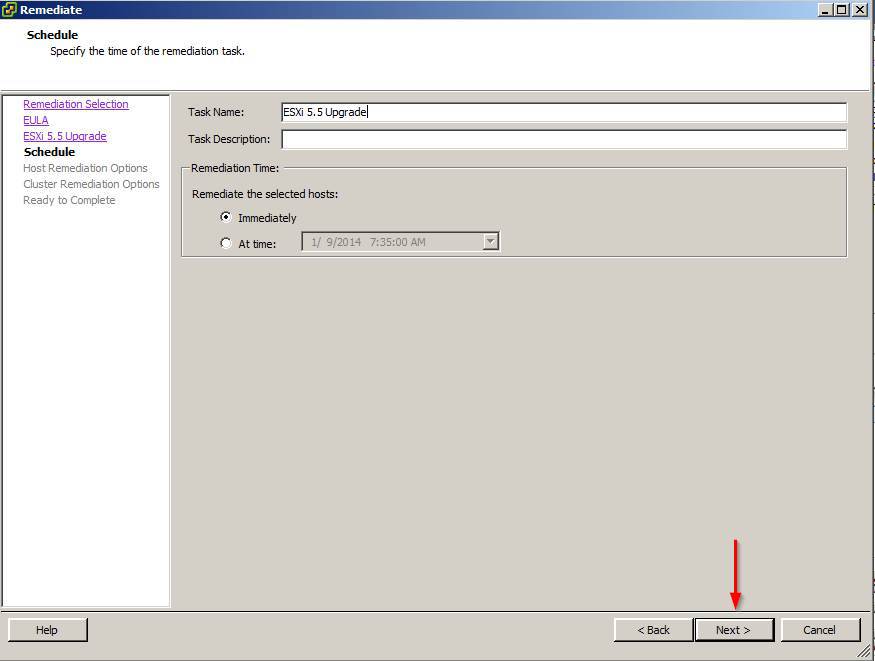
    remediate-schedule
  13. VUM will automatically place the host into maintenance mode if needed and at this screen you can change those settings if you desire. We’ll leave it as default. Click “Next“.
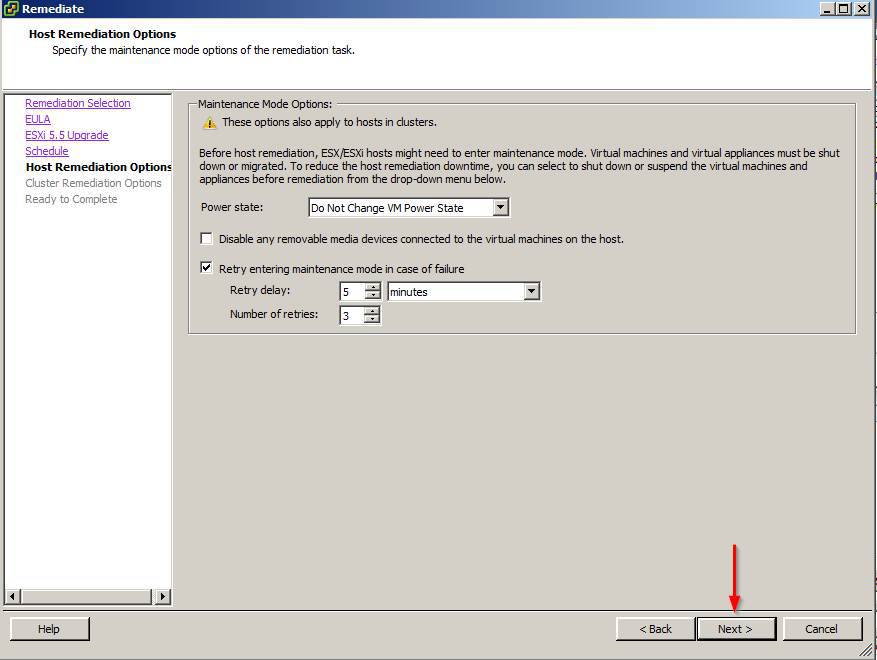
    remediate-host-maintenance-mode
  14. We’ll leave all the defaults for the Cluster Remediation Options as well. Click “Next“.
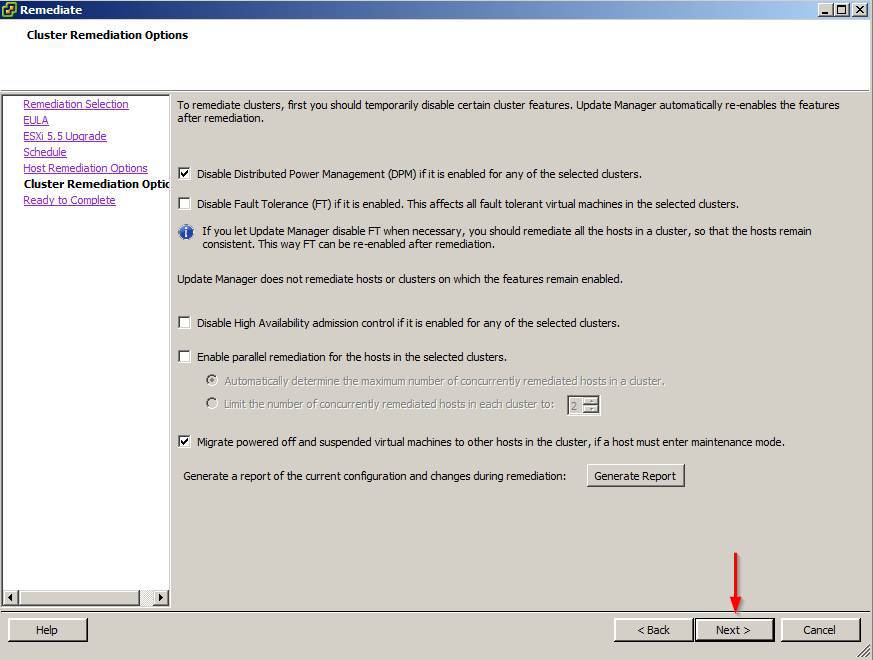
    remediate-options
  15. The only thing left to do now is to look over the confirmation and then click on “Finish“. VUM will then start the upgrade process which can take some time so go get a coffee or in my case, water and wait.
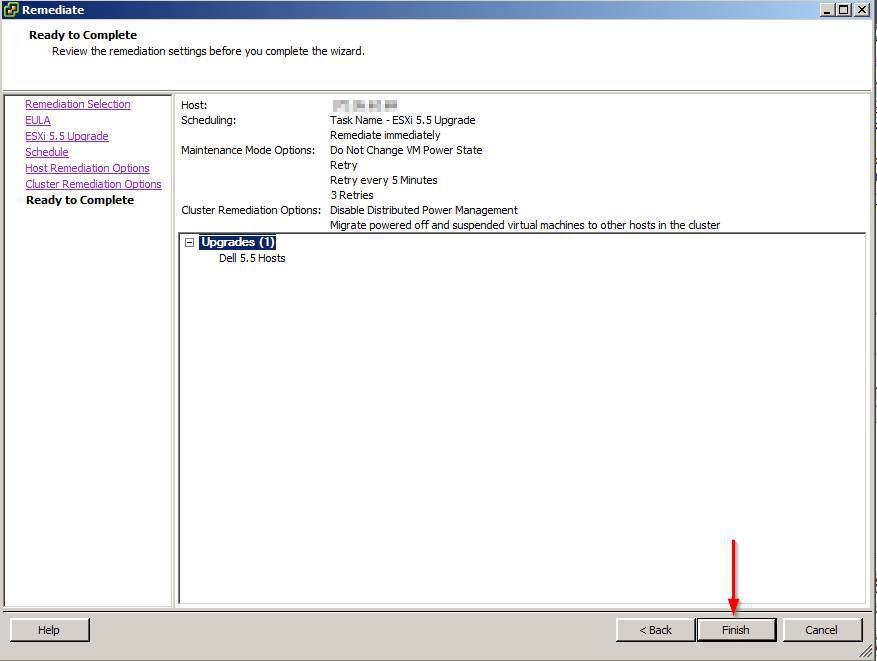
    remediate-confirmation
  16. Once finished you’re host will be running ESXi 5.5. It’s as easy as that!
    host-updated-esxi5.5

Similar Posts

  • My VMware ESXi Home Lab Upgrade

    Although the focus in my career right now is certainly more cloud focused in Amazon Web Services and Azure, I still use my home lab a lot.

    For the last 5+ years my home lab had consisted of using 3x Intel NUC’s (i5 DC53427HYE), a Synology NAS for shared storage and an HP ProCurve switch. This setup served me well for most of those years. It has allowed me to get many of the certifications I have, progress in my career and have fun as well.

    At the start of this year I decided it was time to give the home lab an overhaul. At first I looked at the newest generation of Intel NUC’s but really wasn’t looking forward to dropping over $1,300 on just partial compute (I’d still need to be RAM for each of the 3 NUC’s). I also wanted something that just worked, no more fooling around with network adapter drivers or doing this tweak or that tweak.

    I also no longer needed to be concerned about something that had a tiny footprint. I also questioned if I really needed multiple physical ESXi hosts. My home lab isn’t running anything mission critical and if I really wanted I could always build additional nested VMware ESXi hosts on one powerful machine if I needed.

    So in the end, the below is what I settled on. Replacing all of my compute, most of my networking and adding more storage!

    Read More “My VMware ESXi Home Lab Upgrade”

  • VMware vCenter Server 5.5 Update 1b released

    vCenter Server 5.5 Update 1b released

    VMware released vCenter Server 5.5 Update 1b today. The release does not bring any new features but instead patches a few bugs and possible security issues such as the heartbleed fix and most recent OpenSSL as mentioned in CVE-2014-0224. vCenter 5.5 Update 1b now includes the OpenSSL library which has been updated to versions openssl-0.9.8za, openssl-1.0.0m, and openssl-1.0.1h.

    Read More “VMware vCenter Server 5.5 Update 1b released”

  • VMware Workstation 8.0.4 released

    VMware has just released it’s forth minor update for VMware Workstation 8, bringing it up to 8.0.4. The looks to contain mostly a few bug and security fixes.

    General Issues

    • Linux guests running the Linux kernel version 2.6.34 or later could not be pinged from the host via an IPv6 address.
    • On rare occasions, Linux guests would suddenly fail to Autofit or enter Unity.
    • Unity mode would exit if the title bar of an application contained certain non UTF-8 encoded extended ASCII characters.
    • On Windows hosts, the VMware Workstation user interface sometimes became unresponsive when minimized from full-screen mode if the suggestion balloon was being displayed.
    • On Windows hosts, the user interface sometimes became unresponsive if the application was rendered on an extended display that was abruptly disconnected.

    Read More “VMware Workstation 8.0.4 released”

  • Install ESXi 5.1 from a USB Flash Drive

    Many servers already come with a DVD/CD-ROM drive or some kind of ability to virtually mount an ISO image from a network share onto your server to then install ESXi. However, not all do or you just want to have your ESXi image readily available. Here’s a quick step by step instructions on how to use a USB flash drive to install ESXi.

    1. Download ESXi 5.1 from VMware (if you haven’t already) as well as UNettbootin.
    2. Plug in your USB Flash Drive.
    3. Open UNetbootin and select “Diskimage”, set Type to “USB Drive”, select Drive letter of your USB flash drive, and set the path of your ESXi 5.1 ISO image. Then click on “OK”.
      unetbootin setup
    4. Read More “Install ESXi 5.1 from a USB Flash Drive”

  • How-to fix VMware Converter error FAILED: Unable to find the system volume, reconfiguration is not possible.

    I was recently tasked with migrating a Hyper-V machine to our VMware environment. However, each time VMware Converter was ran, the task would fail at 97% with an error “FAILED: Unable to find the system volume, reconfiguration is not possible.“.

    FAILED: Unable to find the system volume, reconfiguration is not possible

    Looking further into the virtual machine there were a number of concerns I had on the VM. One such issue which I believe might be causing the above error, is that the system volume drive was on drive 0 while the “C:” drive was on drive 1. Whereas these are typically on the same drive in most Windows installs.

    Below are the steps I took to fix this VM and made the migration from Hyper-V to VMware a success.

    Read More “How-to fix VMware Converter error FAILED: Unable to find the system volume, reconfiguration is not possible.”

  • How to fix vRealize Orchestrator 6 appliance, weak ephemeral Diffie-Hellman key

    vrealize orchestrator chrome error

    I’ve recently deployed the vRealize Orchestrator appliance (6.0.2) and noticed right away that my default browser Firefox, would not load the Orchestrator appliance web panel. Firefox always complained about a weak Diffie-Hellman key.

    An error occurred during a connection to ip-address:8281. SSL received a weak ephemeral Diffie-Hellman key in Server Key Exchange handshake message. (Error code: ssl_error_weak_server_ephemeral_dh_key)

    At the time I simply ignored it and just tried Google Chrome which it worked fine. That was until the latest release also broke with the same type of error message:

    Server has a weak ephemeral Diffie-Hellman public key“.

    I now had a problem and contacted VMware support, below is the very easy fix to make vCO 6 work in both the latest version of Firefox and Chrome!

    Read More “How to fix vRealize Orchestrator 6 appliance, weak ephemeral Diffie-Hellman key”

Leave a Reply

Your email address will not be published. Required fields are marked *

2 Comments