Easy ESXi 6.0 upgrade via command line

VMware has released ESXi 6.0 back in March and I recently posted a guide on how to upgrade your vCenter Server Appliance from 5.x to 6.0 – Now we’re going to look at two ways to upgrade a VMware ESXi 5.x host to ESXi 6.0 via command line.

The first method will show you how to have each ESXi host download the update directly from VMware and then upgrade itself while the second method shows how to download the update, place it on a datastore accessible to the host, then upgrade the host.

Upgrade ESXi 6.0 via command line using VMware Online Depot

Using the VMware Online Depot is a simple way to upgrade if you only have 1 or 2 ESXi hosts to do, perfect for a small home lab setup.

  1. Place the host you want to upgrade into Maintenance Mode.
  2. On the host you’re about to upgrade, go to the Configuration tab > Security Profile and Enable SSH under Services.
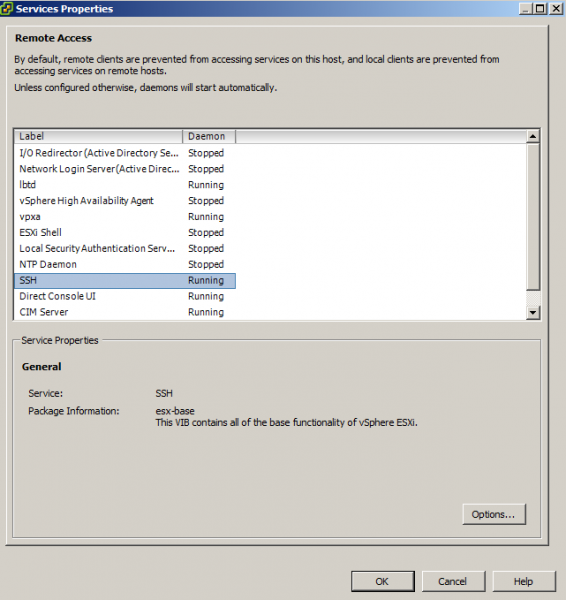
    ssh enabled
  3. Open PuTTY (or any other SSH client) and SSH into your host.
  4. Type the following command to open the firewall for outgoing HTTP requests:
    esxcli network firewall ruleset set -e true -r httpClient
  5. Type the following command to download and upgrade to the latest version of ESXi 6.0 (as of April 10, 2015)
    esxcli software profile update -d https://hostupdate.vmware.com/software/VUM/PRODUCTION/main/vmw-depot-index.xml -p ESXi-6.0.0-20150404001-standard
  6. Once the above completes reboot your host by typing:
    reboot
  7. After the host has been rebooted PuTTy back into the host and disable the HTTP firewall rule by typing:
    esxcli network firewall ruleset set -e false -r httpClient
  8. Doesn’t hurt to also disable SSH when you’re done for security purposes.
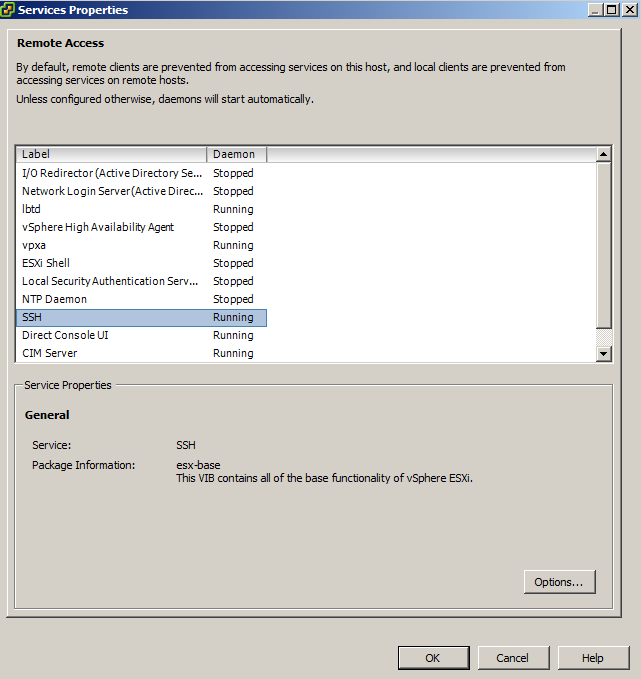
That’s it, your ESXi host has how been upgraded to the latest ESXi 6.0 build, as of April 10, 2015, which does include the newest set of patches found in KB 2111975.

Use the Offline Bundle zip file to upgrade ESXi 6.0 using command line.

Using this process will allow you upgrade your ESXi hosts fairly quickly without the need of having to download the update each time on every host as the above process does.

  1. Download the ESXi 6.0 offline bundle zip file.
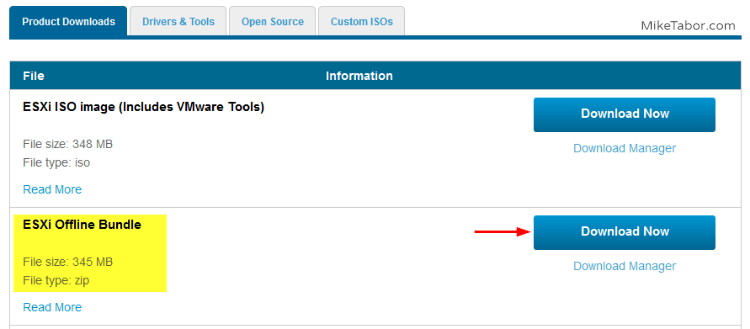
    ESXi 6.0 offline bundle
  2. Upload the VMware-ESXi-6.0.0-2494585-depot.zip file to a datastore accessible by the host.
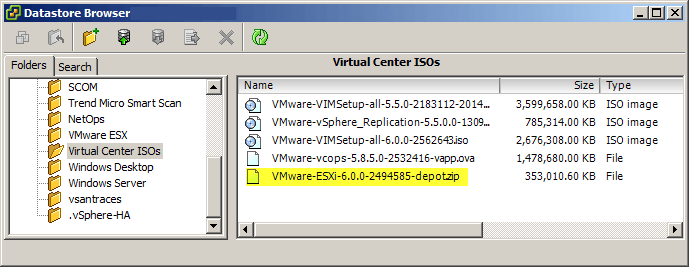
    ESXi 6 bundle uploaded to datastore
  3. Now place the host you want to upgrade into Maintenance Mode.
  4. Then on the host you’re about to upgrade, go to the Configuration tab > Security Profile and Enable SSH under Services.
    ssh enabled
  5. Open PuTTY (or any other SSH client) and SSH into your host.
  6. Type the following command, replace “DATASTORE” with the name of your datastore you uploaded the VMware-ESXi-6.0.0-2494585-depot.zip file to.
    esxcli software vib update -d /vmfs/volumes/DATASTORE/VMware-ESXi-6.0.0-2494585-depot.zip
  7. Once the above completes reboot your host by typing:
    reboot

That’s it, now enjoy your newly upgraded ESXi hosts to ESXi 6.0.

If you have a lot of hosts to upgrade the faster way would most likely be to use VMware Update Manager (VUM). For more details about VUM be sure to check out my post on how to upgrade ESXi host to ESXi 5.5 using VMware Update Manager 5.5 – the process is largely the same minus using an ESXi 6.0 ISO obviously.
Similar Posts

  • VMware Horizon View White Papers

    VMware has been on a roll here lately releasing new technical white papers for VMware Horizon View. If you already have a View environment or about to roll one out, I’d recommend reading these papers to make sure you’re following the recommended best practices.

    Also, be sure to check out my View Windows 7 Optimization Guide as well.

  • VMware View client now availabe for Android!

    VMware has announced that they have released a View Client for Android tablets available on the Android Market now. Here are just a few of the features found on the new client.

    • A new look and feel – The View Client for Android features the NEW blue look and feel of the VMware View clients!
    • Multiple broker support – If you have more than one VMware View broker in your organization, you can can easily access your desktop from all of them via the Android client
    • Desktop Shortcuts – Quickly connect with as many as four recent desktop via shortcuts
    • Virtual trackpad – Control your desktop on a granular level just like you would control the mouse on a laptop
    • Custom keyboard toolbar – Super easy access to all of the special keys not found on the Android default keynboard
    • Honeycomb 3.x support – Made from the ground up for the new generation of Android tablets
    • Custom gestures – Invoke keyboard, scrolling, etc are as easy as ever and simple to use
    • VMware View Security Server support (best experience) – No need to have VPN when you use VMware View Security Server
    • Background tasking – Switch between apps on your tablet and come right back
  • Increase incremental backup speed by enabling CBT

    In a recent VMware environment I was working in, we noticed that our incremental backups was taking a long time (like up to 7-8 hours) to complete. After digging around it was found that VMware actually has a feature built-in since version 4 called Change Block Tracking (CBT). CBT will track any blocks that were changed since the last backup and tag them and stores the information in a -CTK file. The obvious benefit is that now the third party software only backs up the changed block and not the entire VM each time, reducing the amount of data being backed thus speeding up backups and even lowers the CPU utilization on the VM host.

    CBT is disabled by default though there are some backup tools that will enable it automatically or you can enable it manually which can easily be done following these steps:

    Read More “Increase incremental backup speed by enabling CBT”

  • VMware’s Dual Persona smartphones now available at Verizon Wireless

    VMware Ready for Verizon

    VMware has announced that the Android running LG Intuition and Motorola Razr M can now both be purchased with VMWare Horizon Mobile software. The VMWare Horizon Mobile software separates the devices into isolated partitions that allow users to keep their work applications and data separate from their personal applications and data.

    Today, VMware and Verizon Wireless announced that the Android-based LG Intuition and Motorola Razr M can now be purchased with VMware’s Horizon Mobile software, which separates the device into isolated partitions that keep a user’s work applications and data separate from personal stuff. Licenses to Horizon Mobile start at $125 per user and can be purchased through local resellers of VMware and Verizon Wireless.

    Read More “VMware’s Dual Persona smartphones now available at Verizon Wireless”

  • My VMware ESXi Home Lab Upgrade

    Although the focus in my career right now is certainly more cloud focused in Amazon Web Services and Azure, I still use my home lab a lot.

    For the last 5+ years my home lab had consisted of using 3x Intel NUC’s (i5 DC53427HYE), a Synology NAS for shared storage and an HP ProCurve switch. This setup served me well for most of those years. It has allowed me to get many of the certifications I have, progress in my career and have fun as well.

    At the start of this year I decided it was time to give the home lab an overhaul. At first I looked at the newest generation of Intel NUC’s but really wasn’t looking forward to dropping over $1,300 on just partial compute (I’d still need to be RAM for each of the 3 NUC’s). I also wanted something that just worked, no more fooling around with network adapter drivers or doing this tweak or that tweak.

    I also no longer needed to be concerned about something that had a tiny footprint. I also questioned if I really needed multiple physical ESXi hosts. My home lab isn’t running anything mission critical and if I really wanted I could always build additional nested VMware ESXi hosts on one powerful machine if I needed.

    So in the end, the below is what I settled on. Replacing all of my compute, most of my networking and adding more storage!

    Read More “My VMware ESXi Home Lab Upgrade”

  • VMware Certified Professional 6 (VCP6-DCV) now available

    VMware VCP DCV

    VMware has just recently announced that the VMware Certified Professional 6 (VCP6-DCV) is now available. The new VCP6 exam is similar to the others in the past whereas the VCP6 aims to validate your ability to deploy, configure, administer and scale a vSphere virtualized data center, including administering and troubleshooting virtualization technologies such as:

    • vSphere HA and DRS Clusters
    • Storage virtualization using VMFS
    • Storage DRS and Storage I/O Control
    • Network virtualization using vSphere standard and distributed switches and Network I/O Control
    • vSphere management using vCenter Server and vRealize Operations Manager Standard
    • Virtual Machines

    Read More “VMware Certified Professional 6 (VCP6-DCV) now available”

Leave a Reply

Your email address will not be published. Required fields are marked *

One Comment

  1. You say ‘april 10’ a few times, but you appear to be updating to april 1: ‘ESXi-6.0.0-20150404001’ . Probably that’s the last one before the 10th, but if you’re choosing an arbitrary date you may want to explain that it’s not a typo (10 vs 01) . :-D