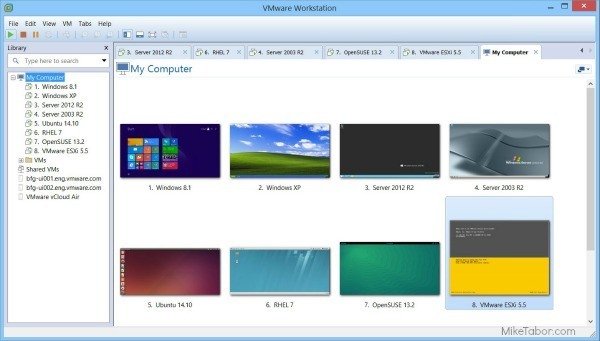
How to create a bootable VMware ESXi installer USB flash drive

I’ve mentioned how to create a bootable VMware ESXi installer USB flash drive in an older post, but wanted to detail the steps I use to create an ESXi bootable install drive.

Creating a bootable flash drive is very useful for machines without a CD-Rom or remote access like an iDRAC where you can virtually mount an ISO image – such as the Intel NUC.

The process is very easy with just one tool needed, Rufus – if you don’t already have it go ahead and download it now!

Creating a bootable ESXi flash drive

  1. Download VMware ESXi ISO image from VMware.
  2. Connect your flash drive to your computer.
  3. Open Rufus and in the Device drop down select your USB flash drive.
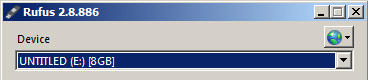
    rufus select device
  4. Click the icon that looks like a CD to select the ESXi ISO image you’ve downloaded.
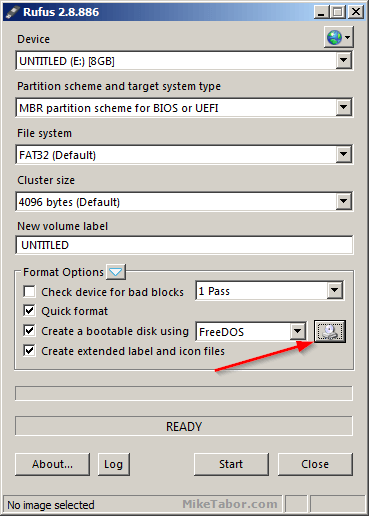
    rufus select image
  5. Now click on Start.
  6. Next you’ll be prompted to replace menu.c32, answer Yes.
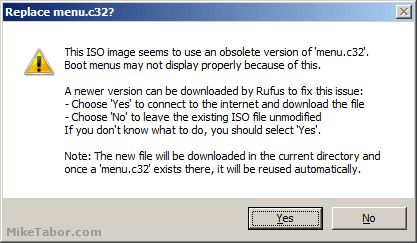
    rufus replace menu.c32

That’s it! Rufus will write the ISO image to the USB thumb drive and you’ll be able to boot your Intel NUC or server from the flash drive and install ESXi.

Since the installer gets loaded into memory you can also install ESXi right onto the same flash drive, which is exactly what I did when I setup my three Intel NUC‘s in my home lab.

Similar Posts

  • How to fix VMware Converter error “FAILED: The VSS snapshots cannot be stored”

    While moving some VM’s from Hyper-V to VMware using VMware Converter a VM failed to convert with the error: FAILED: The VSS snapshots cannot be stored.

    FAILED: The VSS snapshots cannot be stored because there is not enough space on the source volumes or because the source machine does not have any NTFS volumes. Error code: 2147754783 (0x8004231F).

    Come to find out the System Reserved partition was full. Our soon to be retired Appassure backup application was nice enough to fill up the volume.

    Luckily Appassure is being replaced by Veeam and fixing the above VMware Converter error is an easy fix.

    Read More “How to fix VMware Converter error “FAILED: The VSS snapshots cannot be stored””

  • VMware ESXi 5 home lab upgrade

    In the past I’ve been using a single server to run my VMware ESXi home lab. it was slow, old, big and loud. I’ve been meaning to upgrade my home lab for a while and just never got around to it, until now! When looking for new hardware I wanted the servers to be as compact as possible, quiet, and low energy usage as possible while still having some horsepower.

    I debated on going the whitebox solution as I build all my own desktops anyway, I also looked at several other solutions such as the HP ML310e server, Shuttle XH61V barebones machine, but ultimately decided to go with two Intel NUC i5’s.

    Intel NUC i5 and 16GB ram

    Intel NUC i5 DC53427HYE Features:

    • Uses very little energy
    • Completely quiet
    • Supports up to 16GB RAM
    • A dual core CPU that scores nearly 3,600 in PassMark benchmarking
    • Includes vPro which allows me to easily run both NUC’s headless
    • Extremely small, nearly 4 1/2″ inch square footprint

    Read More “VMware ESXi 5 home lab upgrade”

  • VMware Workstation 11 released

    VMware Workstation 11 Unmatched OS Support

    At the start of October VMware announced Workstation 11, along with VMware Player 7 Pro and said both products would be available sometime in December. Well today is the day, VMware has now officially released VMware Workstation 11!

    Workstation 11 adds support for the latest version of Windows and Linux, as well as the latest processors and hardware, and also adds the ability to connect to VMware vCloud Air.

    Read More “VMware Workstation 11 released”

  • Thank you VMware Community!

    VMware vExpert 2014

    So far, 2014 has been a very rewarding year for a number of reasons, two of which has happened in just a week or two span. First, Eric Siebert (@ericsiebert) announced on March 27th, this years results of the 2014 Top VMware & Virtualization Blog voting. My first year entered into voting and made it to 71st place! A huge thanks goes out to not only Eric but just as much so to everyone who voted for me!

    To top it off, yesterday VMware announced 2014’s first quarter VMware vExpert list. While vExpert isn’t a technical certification or even a general measure of VMware expertise. The VMware judges selected people who were engaged with their community and who had developed a substantial personal platform of influence in those communities. There were a lot of very smart, very accomplished people, even VCDXs, that weren’t named as vExpert this year. VMware awarded this title to 754 people this year and on that list of many impressive names you’ll find yours truly, Michael Tabor!

    I’m both honored and humbled by both lists. It’s a great feeling to be recognized by not only my peers through the voting in the Top vBlog but also by VMware themselves through the vExpert title.

    So again THANK YOU very much to the entire VMware community, a spectacular community indeed, and congratulations to everyone else that made the Top vBlog and vExpert lists!

  • How to install VMware vSphere Update Manager 5.5

    If you don’t already know, VMware Update Manager (aka, VUM) is a tool which allows you to easily automate patching and upgrading VMware hosts as well as virtual machine hardware and VMware tools. It’s a wonderful tool and makes upgrading and patching so much easier and allows you to quickly see how compliant/up-to-date your environment is with the built in pie graph.

    Recently we had some pretty serious array issues which corrupted the VUM database taking Update Manager down. Since we was going to have to rebuild Update Manager I opted to move from Windows Server 2008 to Windows Server 2012, in the steps below I’ll document step by step how to install VMware Update Manager 5.5 on Server 2012 and a separate database.

    Read More “How to install VMware vSphere Update Manager 5.5”

  • Upgrade VCSA 6.5 to VCSA 6.7 Update 1

    VMware vCenter 6.7 U1 has recently been released. Last week I posted how to upgrade VCSA 6.7 to 6.7 Update 1, this post will walk you though upgrading VMware vCenter Server Appliance 6.5 to VCSA 6.7 Update 1!

    When doing a VCSA version upgrade the upgrade process is much different, than going from say 6.7 to 6.7 U1. When going from 6.5 to 6.7 the upgrade is actually broken up into two stages.

    The first stage involves deploying a brand new vCenter 6.7 appliance. Then the second stage will copy the data from your 6.5 VCSA into the newly deployed 6.7 VCSA from stage 1.

    Read More “Upgrade VCSA 6.5 to VCSA 6.7 Update 1”

Leave a Reply

Your email address will not be published. Required fields are marked *