How to perform Instant File Recovery using NAKIVO Backup

NAKIVO Backup has been a great addition in my home lab and just a few months ago I wrote about my first impressions of NAKIVO Backup. Now I have a few posts lined up to highlight some individual features of NAKIVO Backup, starting with Instant File Recovery.

If you haven’t already guessed it, Instant File Recovery allows you to recover files or folders directly from a previous backup job. This is a great alternative to performing a full restore of a VM when all you might need is a single or even a couple of files and/or folders.

Performing a NAKIVO Instant File Recovery

  1. Log into your NAKIVO Dashboard and go to Recover > Individual files.
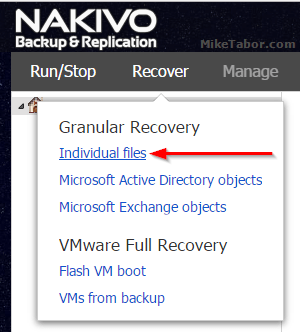
    nakivo instant file recovery individual files
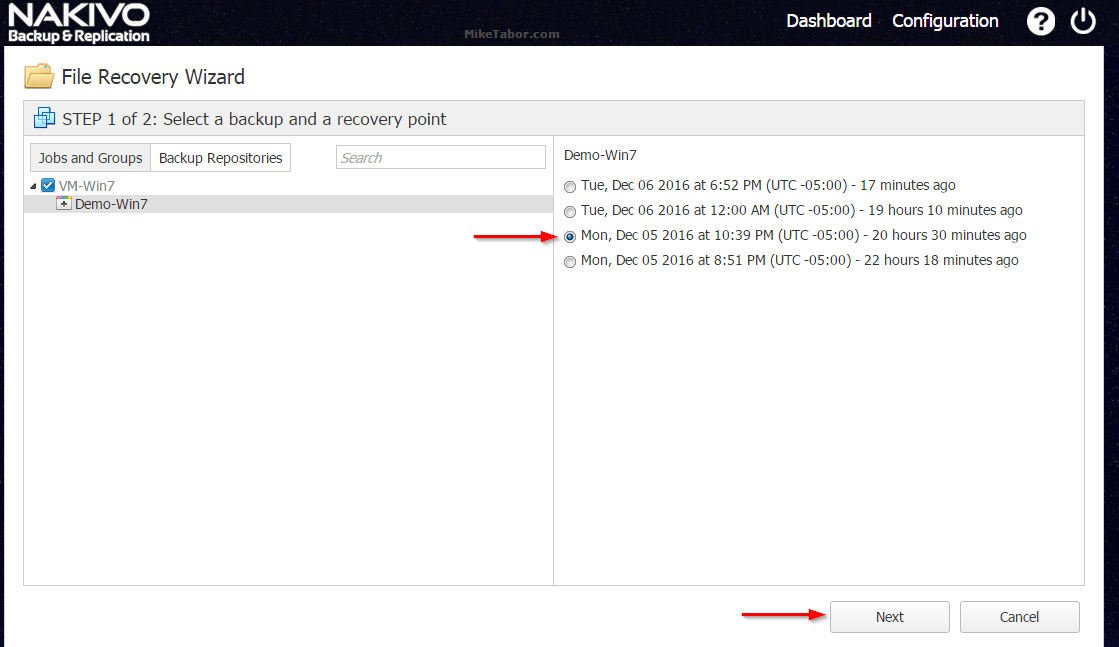
  2. Next select the Backup Job & VM you want to recover from and then select which Recovery Point you want to restore from and click Next.
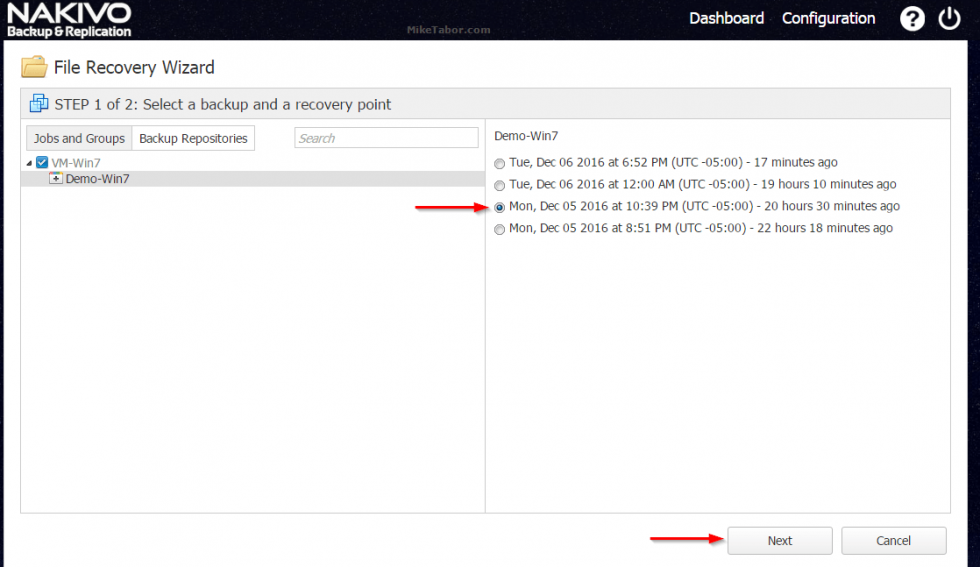
    nakivo instant recovery select recovery point
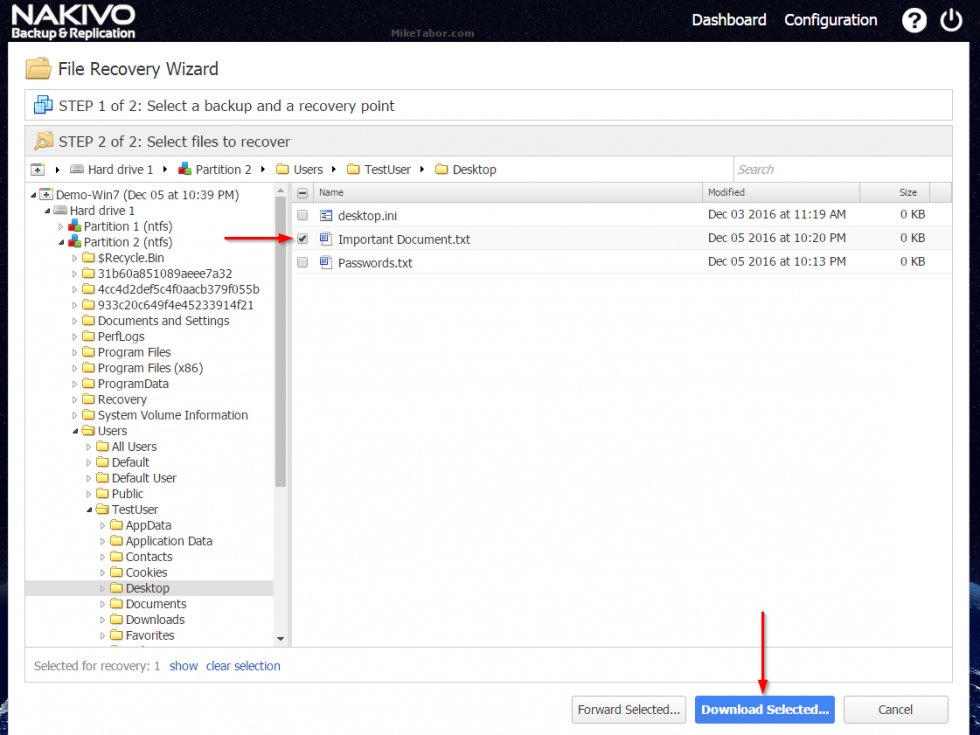
  3. Now drill down to the location of the file or folder you would like to restore. In this case I have several files located on the Desktop and I chose to restore the “Important Document.txt” file.

    Simply click on Download Selected… to download the selected file or folder which will download it directly to your local computer as a .ZIP file. Alternatively, you can have it emailed to someone by clicking on “Foward Selected…
    nakivo instant file recovery select file restore

That’s all there is to it! Now simply do as you need with the downloaded file or folder.

NAKIVO Instant File Recovery Requirements

It’s also worth mentioning, there are a few requirements to make note of, which you can read here.

Most notably would that while NAKIVO Backup supports all VM file systems, if a Transporter is installed on Windows then only NTFS & FAT32 are supported. If the Transporter is installed on Linux then NFTS, FAT32, EXT3, EXT4, & XFS file systems are supported.
Similar Posts

  • How to run Crashplan in Docker on Synology NAS

    Crashplan running in Docker on Synology

    I am a huge fan of CrashPlan and have been using it for years on my Synology NAS using this install guide I wrote up some time ago.

    Admittedly the process in the old guide wasn’t always roses. Crashplan would push out an update and that update would, at times, break the Synology Crashplan client from PC Load Letter and backups would stop running for a couple days – maybe a week. Patters being the awesome guy he is, usually updated his Synology Crashplan package quickly and all was good again.

    Then last year in DSM 5.2, Synology added support for Docker which opened up the possibility to run all sorts of software in a virtual container running on your Synology NAS. One such software being Crashplan and below I’m going to show how I now have Crashplan running in Docker on my Synology DS1815+ NAS!

    Read More “How to run Crashplan in Docker on Synology NAS”

  • Increase incremental backup speed by enabling CBT

    In a recent VMware environment I was working in, we noticed that our incremental backups was taking a long time (like up to 7-8 hours) to complete. After digging around it was found that VMware actually has a feature built-in since version 4 called Change Block Tracking (CBT). CBT will track any blocks that were changed since the last backup and tag them and stores the information in a -CTK file. The obvious benefit is that now the third party software only backs up the changed block and not the entire VM each time, reducing the amount of data being backed thus speeding up backups and even lowers the CPU utilization on the VM host.

    CBT is disabled by default though there are some backup tools that will enable it automatically or you can enable it manually which can easily be done following these steps:

    Read More “Increase incremental backup speed by enabling CBT”

  • Restore a VM using the {vm}-flat.vmdk file

    missing vmdk file error

    A couple days ago I was asked the question “An admin deleted the vmdk file associated with a VM, there are no snapshots or backups of the VM . Can we restore this VM somehow?“. I believe in backups, I like to have my VM’s backed up so that I can depend on them for events just like this very issue. At first I was stumped, until the {vm-name}.flat.vmdk was mentioned. That’s when I remembered a method to recover a VM using the vm-flat.vmdk file that I had actually done 2-3 years ago.

    Read More “Restore a VM using the {vm}-flat.vmdk file”

  • How to install Backblaze on Synology NAS

    In case you’ve missed it, Crashplan announced yesterday that they are no longer offering a family backup plan but instead focusing on business plans. Immediately people started asking me on twitter for alternatives.

    Well one option would be to upgrade to the more expensive Crashplan business plan or another option would be to check out Backblaze!

    In this post I’ll be showing you just how easy it is to use Backblaze on your Synology Diskstation NAS – all with native Synology apps. No need to worry about upgrades breaking your backups or 3rd party solutions!

    Read More “How to install Backblaze on Synology NAS”

  • Use Pi-Hole to block ads on all devices in your network

    Sure ad blockers have been around for a long while now, but those are typically only available for your web browsers and not ever device allows you to install them such as cell phones, media players, smart TV’s, etc. I came across a neat project that allows you to block web ads on every device in your network, called Pi-Hole.

    In a nutshell Pi-Hole was developed to run on a Raspberry Pi, but will run on most any Debian based distro, and will act as a DNS server to which you point your devices or router to use as the DNS server so that all requests are filtered through Pi-Hole. Pi-Hole then blocks 100’s of thousands ad domains. All without having to use a single browser extension and for FREE!

    Read More “Use Pi-Hole to block ads on all devices in your network”

  • Crucial 16GB memory, perfect for Intel NUC

    crucial 16gb 204pin memory

    I’m a huge fan the of Intel NUC‘s for a VMware home lab. In fact I just recently picked up my third Intel NUC to give me more head room for a small VMware Horizon (View) environment at home.

    I typically use G.Skill memory in my NUC’s as I’ve had great luck with the brand in my desktop and laptop for years. However G.Skill has been increasing in price which made me look around for alternatives and came across Crucial DDR3 204-pin memory for less money, but days after I purchased it they too went up in price. However they are now back on sale and cost about $50 less then the G.Skill memory I have been using in my first two NUC’s.

    I’ve been using the Crucial memory now for the last several months without any problems and even though they are rated at a lower voltage I can’t say I really see any difference in power savings or consumption compared to the G.Skill 1.5V. If you’re looking to upgrade now might be a good time to take advantage of the sale price.

Leave a Reply

Your email address will not be published. Required fields are marked *