Increase incremental backup speed by enabling CBT

In a recent VMware environment I was working in, we noticed that our incremental backups was taking a long time (like up to 7-8 hours) to complete. After digging around it was found that VMware actually has a feature built-in since version 4 called Change Block Tracking (CBT). CBT will track any blocks that were changed since the last backup and tag them and stores the information in a -CTK file. The obvious benefit is that now the third party software only backs up the changed block and not the entire VM each time, reducing the amount of data being backed thus speeding up backups and even lowers the CPU utilization on the VM host.

CBT is disabled by default though there are some backup tools that will enable it automatically or you can enable it manually which can easily be done following these steps:

Enable Change Block Tracking (CBT) on a VM

  1. Power off the VM, then right click on it and select Edit Settings… > Options Tab > General > and click on Configuration Parameters.
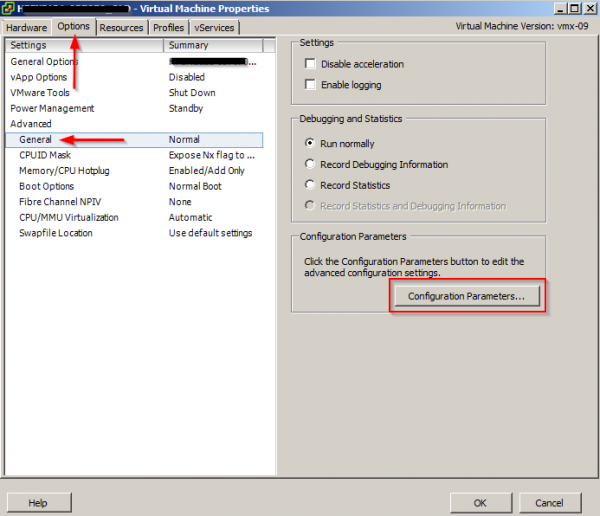
    vm properties
  2. Click on Add Row and add:
    ctkEnabled = True
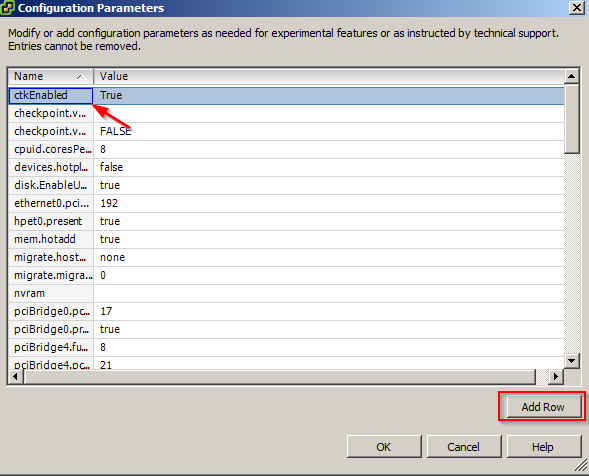
    configuration parameters

  3. Then for each virtual disk on your VM, add the following:
    scsix:x.ctkEnabled = True

    Replacing X with the controller and disk number of each disk. On my virtual machine I have two disks attached:

    vm disk1

    vm disk2
    Entered as:

    scsi0:0.ctkEnabled = True
    scsi1:0.ctkEnabled = True
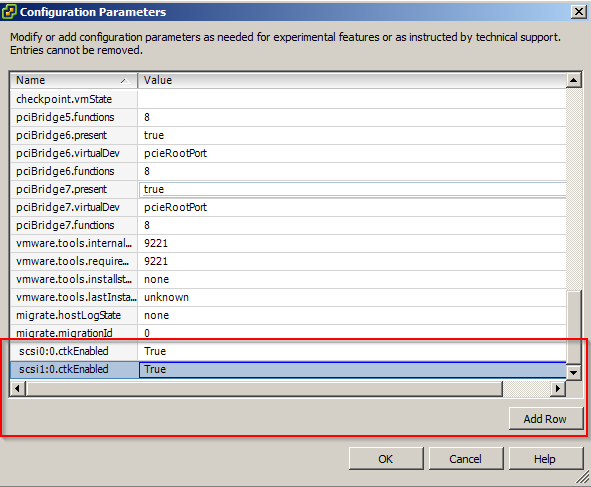
    configuration parameters adding a disk

  4. Now click on OK and power on the VM.
  5. When you browse the Datastore for the VM you will see a vmname-CTK.VMDK file for each drive

Requirements to enable Change Block Tracking

  • VM needs to be running hardware version 7.0 or newer
  • ESXi host much be version 4.0 or newer
  • Virtual Disks: Thin, Thick, Virtual RDM are compatible, RDM in physical compatibility mode is NOT supported.

Disable Change Block Tracking (CBT) on a VM

  1. Power off the VM and re-open Configuration Parameters
  2. Change
    ctkEnabled = True

    to

    ctkEnabled = False

After enabling CBT in the environment I spoke of above, incremental backups was now only taking 30mins to an 1 hour to complete!

Note: VMware does acknowledges that CBT could lose track of incremental changes in the event of a power failure or hard shutdown.
Similar Posts

  • VMware vSphere 7 announced

    VMware vSphere 7

    Some pretty big news coming out of VMware today. The announcement of VMware vSphere 7 to become available May 1, 2020! One of the biggest item coming out of this news so far is that vSphere 7 will come in two options.

    The first being vSphere 7 as we all have known it to be for years and then the second being vSphere 7 with Kubernetes which will be available through VMware Cloud Foundation and is a new generation of vSphere for containerized applications.

    Other notables is that the flash based vSphere client is FINALLY no more! From here on out, only the HTML 5 will exist. vCenter Server on Windows will also finally be put to rest and new deployments of vCenter server will be done using the tried and tested vCenter Server Appliance (VCSA) based on PhotonOS linux.

    Read More “VMware vSphere 7 announced”

  • How to install VMware vCenter Log Insight

    VMware vCenter Log Insight

    Log Insight is a real-time log management and analytics solution, and one of VMware’s newest product. Log Insight was recently updated to version 2.0 and available to download here.

    Below we’ll go through the steps to installing VMware Log Insight and you’ll soon see just how easy it is to get Log Insight up and running.

    Read More “How to install VMware vCenter Log Insight”

  • How to upgrade ESXi 6.5 to ESXi 6.7

    VMware released ESXi 6.7 a little while ago, but it’s only been here recently have I started deploying it in my home and work lab environments. Below are two ways to easily upgrade your ESXi 6.5 hosts to ESXi 6.7 using the command line or by using the VMware ESXi offline bundle.

    Read More “How to upgrade ESXi 6.5 to ESXi 6.7”

  • VMware Workstation updated to 9.0.2

    VMware is released a maintenance update for VMware Workstation to version 9.0.2. The update is available for free for all VMware Workstation 9.x customers.

    Mostly just bug fixes and a few improvements, here are a few highlights:

    • Fedora 18 supported as a guest operating system
    • Windows 8 host permissions issues fixed
    • VMware Tool updated to support the latest Linux kernels
    • Improved general host resource management
    • OVF Tool has been updated to version 3.0.2
    • Virtual machine sharing improvements
    • Memory leak which impacted Windows hosts has been fixed

    Read More “VMware Workstation updated to 9.0.2”

  • VMware Recertification Policy

    VMware certified

    Starting today, March 10 2014, new VCP certifications must be re-certified within two years of it’s earned date. Anyone who currently has their VCP certification prior to March 10 2013 has until March 10, 2015 to re-certify.

    The new policy gives you three options to re-certify:

    1. Take the current exam for your existing VCP certification solution track. For example, if you are a VCP3, you could take the current VCP5-Data Center Virtualization (VCP5-DCV) exam.
    2. Earn a new VCP certification in a different solution track. For example, if you are a VCP-Cloud, you could recertify by earning VCP5-Desktop (VCP5-DT) certification.
    3. Advance to the next level by earning a VMware Certified Advanced Professional (VCAP) certification. For example, if you are a VCP5-DCV you could earn VCAP5-DCA certification.

    I can understand why they are doing this but I don’t agree with the changes. As per the announcement if you let your certification expire, “Your certification will be revoked,and you will no longer be entitled to use the certification logo or represent yourself as VMware certified“. Really? You mean everything that was done prior and after taking the exam means nothing?

    Read More “VMware Recertification Policy”

  • Power off an unresponsive VM using ESXTOP

    Just recently we have some hardware issues in our primary datacenter and during that time had a few VM’s that became unresponsive and needed to get them back online. The VM’s had stopped responding to the normal vSphere commands to reboot, shutdown or even restart. I didn’t want to power cycle the entire ESXi host and instead just power off an unresponsive VM.

    Here is a quick and easy way to do just that using ESXTOP.

    Read More “Power off an unresponsive VM using ESXTOP”

Leave a Reply

Your email address will not be published. Required fields are marked *

2 Comments