VMware P2V Permission to perform this operation was denied fix

Just the other day we had a Windows Server 2008 R2 Standard physical server that needed to be P2V’ed, and after trying to use VMware Converter Standalone 6.1.1 we ran into the error message “Permission to perform this operation was denied” after entering the source machine details.
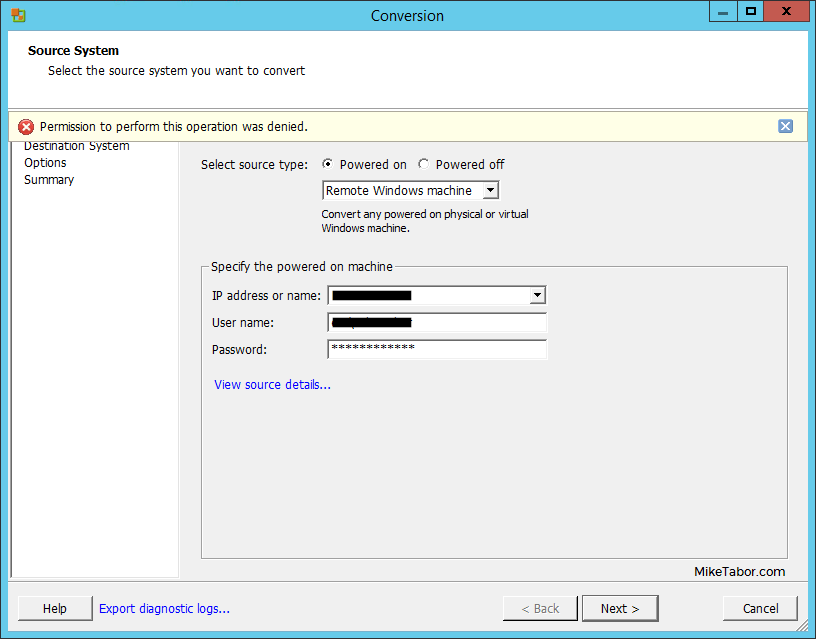
vmware p2v permission denied

Even after trying to start VMware Converter as “Run as administrator” the error persisted. Below is the workaround we performed to quickly allow us to P2V the physical server.

Workaround for Permission to perform this operation was denied

  1. Log into the server you’re trying to convert to a virtual machine.
  2. Open Local Security Policy (open run dialog and type secpol.msc).
  3. Go to: Local Policies > Security Options.
  4. Change “User Access Control: Run all Administrators in Admin Approval Mode” from Enabled to Disabled.
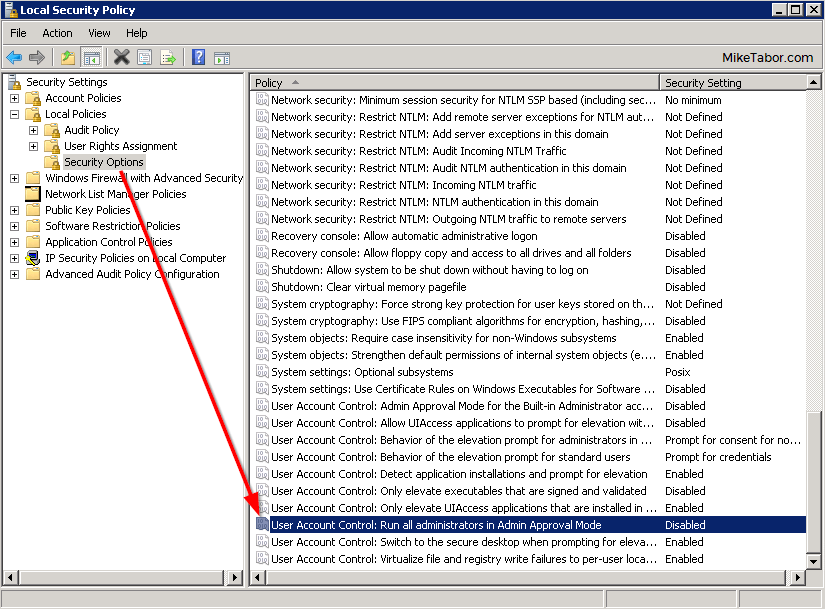
    local security policy disabled p2v
  5. Restart the server to make the changes take effect.
  6. You should now be able perform the P2V without issue.

After making the above change we was able to successfully P2V the server without any further issues:
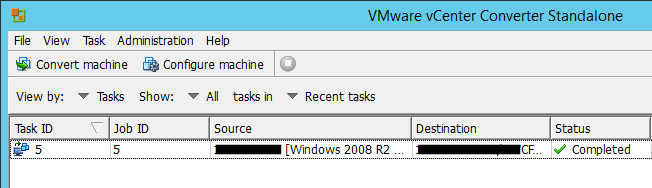
VMware P2V completed

Once you confirm the P2V is successful I would recommend changing User Access Control: Run all Administrators in Admin Approval Mode back to Enabled from Disabled.
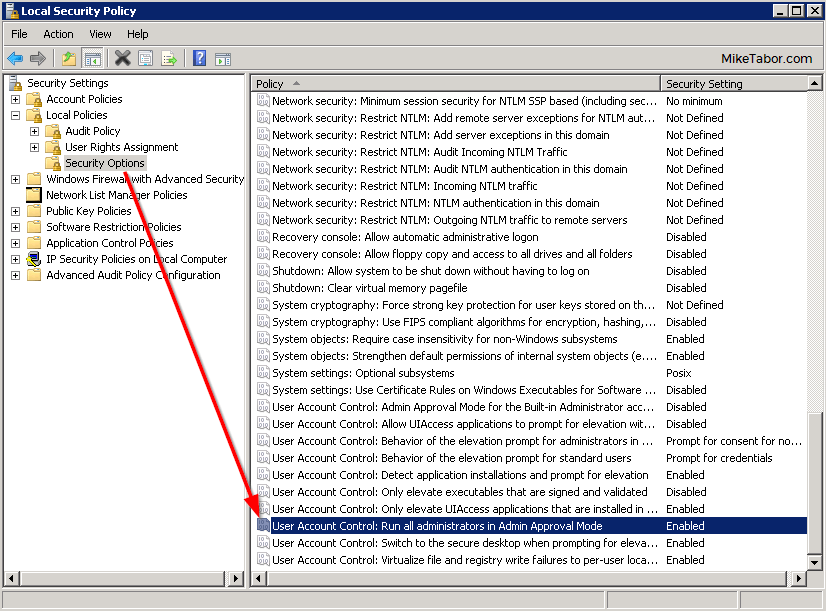
local security policy enabled p2v

If you have another workaround please share in the comments!
Similar Posts

  • VMware vCenter Server 5.5.0a update released

    VMware has released an update to vCenter 5.5 Server. The new updated, numbered 5.5.0a doesn’t appear to add any new features but instead focus on squishing a number of bugs in the 5.5 version – mostly around vCenter Single-Sign-On and the vSphere web client.

    Issues resolved with this release are as follows:

    1. Attempts to upgrade vCenter Single Sign-On (SSO) 5.1 Update 1 to version 5.5 might fail with error code 1603
    2. Attempts to log in to the vCenter Server might be unsuccessful after you upgrade from vCenter Server 5.1 to 5.5
    3. Unable to change the vCenter SSO administrator password on Windows in the vSphere Web Client after you upgrade to vCenter Server 5.5 or VCSA 5.5
    4. VPXD service might fail due to MS SQL database deadlock for the issues with VPXD queries that run on VPX_EVENT and VPX_EVENT_ARG tables

    Read More “VMware vCenter Server 5.5.0a update released”

  • vSphere 5.1 currently not compatible with any VMware View version

    Before you go updating your vSphere to the new 5.1 version that was just released, VMware had just released this alert yesterday (9/12) that vSphere 5.1 is currently NOT compatible with any version of VMware View.

    vSphere 5.1 is in the process of being certified against VMware View. We recommend that you do not upgrade vSphere above the supported versions listed in the VMware View 5.1 Release Notes.

    For further updates and more information on this alert, refer to KB article:
    vSphere 5.1 is not compatible with any versions VMware View (2035268).

    If you don’t use VMware View, and are ready to upgrade to vSphere 5.1 be sure to check out the Installing vCenter Server 5.1 best practices from VMware.

  • How to convert VMDK to OVF file format

    Here is a quick and easy way to convert a VMDK to OVF file format using the OVF Tool from VMware.

    1. First download and install the VMware OVF Tool for your operating system.
    2. Open a command prompt as Administrator and navigate to the OVF Tool install directory:
      
      cd C:\Program Files\VMware\VMware OVF Tool
      

      vmdk to ovf command prompt

    3. Next, type in the following command to convert VMDK to OVF:
      
      ovftool.exe \virtualmachine.vmx \virtualmachine.ovf
      

      convert vmdk to ovf command

    After a few minutes time you should you should see a “Transfer Completed, Completed successfully” message and your VMDK to OVF file conversion is complete and ready for use.
    convert vmdk to ovf complete

  • VMware View client now availabe for Android!

    VMware has announced that they have released a View Client for Android tablets available on the Android Market now. Here are just a few of the features found on the new client.

    • A new look and feel – The View Client for Android features the NEW blue look and feel of the VMware View clients!
    • Multiple broker support – If you have more than one VMware View broker in your organization, you can can easily access your desktop from all of them via the Android client
    • Desktop Shortcuts – Quickly connect with as many as four recent desktop via shortcuts
    • Virtual trackpad – Control your desktop on a granular level just like you would control the mouse on a laptop
    • Custom keyboard toolbar – Super easy access to all of the special keys not found on the Android default keynboard
    • Honeycomb 3.x support – Made from the ground up for the new generation of Android tablets
    • Custom gestures – Invoke keyboard, scrolling, etc are as easy as ever and simple to use
    • VMware View Security Server support (best experience) – No need to have VPN when you use VMware View Security Server
    • Background tasking – Switch between apps on your tablet and come right back
  • VMware Workstation 11 released

    VMware Workstation 11 Unmatched OS Support

    At the start of October VMware announced Workstation 11, along with VMware Player 7 Pro and said both products would be available sometime in December. Well today is the day, VMware has now officially released VMware Workstation 11!

    Workstation 11 adds support for the latest version of Windows and Linux, as well as the latest processors and hardware, and also adds the ability to connect to VMware vCloud Air.

    Read More “VMware Workstation 11 released”

  • VMware vSphere 7 announced

    VMware vSphere 7

    Some pretty big news coming out of VMware today. The announcement of VMware vSphere 7 to become available May 1, 2020! One of the biggest item coming out of this news so far is that vSphere 7 will come in two options.

    The first being vSphere 7 as we all have known it to be for years and then the second being vSphere 7 with Kubernetes which will be available through VMware Cloud Foundation and is a new generation of vSphere for containerized applications.

    Other notables is that the flash based vSphere client is FINALLY no more! From here on out, only the HTML 5 will exist. vCenter Server on Windows will also finally be put to rest and new deployments of vCenter server will be done using the tried and tested vCenter Server Appliance (VCSA) based on PhotonOS linux.

    Read More “VMware vSphere 7 announced”

Leave a Reply to Mike Tabor Cancel reply

Your email address will not be published. Required fields are marked *

12 Comments

  1. Quick thanks and to let folks finding this article know this tip still works (as of 25 Feb 2021) … at least it worked for me …

    – Windows 10 Pro / SP1 (1803) (host to be P2V’d)
    – VMware Workstation 16 Pro (running on host to be P2V’d)
    – VMware vCenter Converter Standalone Client 6.2