Fix VMware VCSA /storage/log filesystem out of disk space

This morning I ran into an issue where users were reporting the production VCSA 6.0 was not allowing them to connect into the web or thick client. Another administrator rebooted the VCSA which seemed to work only briefly. I then logged into the VCSA web management (https://<VCENTER_IP>:5480) and noticed the following health status right away:

The /storage/log filesystem is out of disk space or inodes
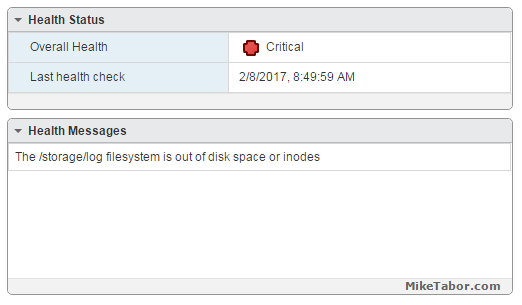
vcsa /storage/log full

So I opened up PuTTY and ran a df -h command and confirmed the issue:
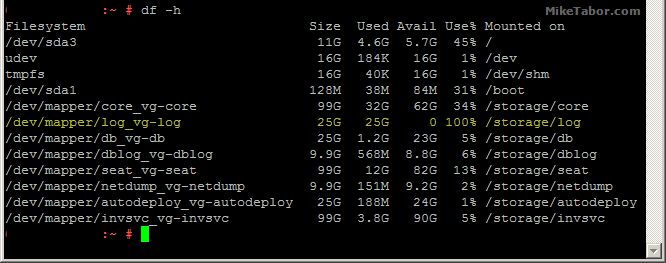
VMware VCSA storage log VMDK full

How to fix VCSA /storage/log filesystem out of disk space

Luckily the fix is rather easy, thanks to a blog post by @lamw that I found while looking for a solution, he mentions in VCSA 6.x you can now expand VMDK’s on the fly since the VCSA takes advantage of LVM.

  1. So open the vSphere client (web or thick) and expand the VMDK (see below table for which VMDK to expand)
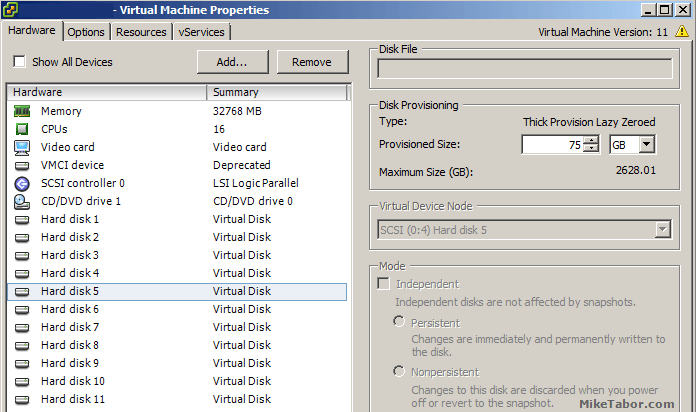
    VCSA /storage/log expand vmdk
  2. Next open PuTTY (or other terminal window) and run the following command on your VCSA
    vpxd_servicecfg storage lvm autogrow
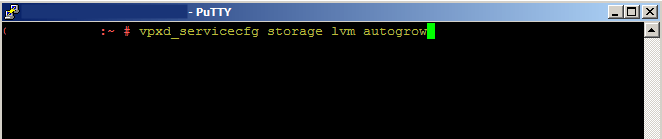
    VCSA /storage/log autogrow vmdk

And that is all there is to it, we now have a healthy VCSA again!
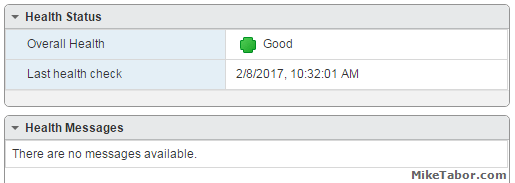
VMware VCSA healthy

VMWare VCSA 6.0 VMDK list and purpose

VMDK Disk Size Mount Point Purpose
VMDK1 12 GB / & /boot Boot
VMDK2 1.3 GB /tmp/mount Temp mount
VMDK3 25 GB SWAP Swap space
VMDK4 25 GB /storage/core Core dumps
VMDK5 10 GB /storage/log System logs
VMDK6 10 GB /storage/db Postgres DB location
VMDK7 5 GB /storage/dblog Postgres DB logs
VMDK8 10 GB /storage/seat Stats, events, and tasks (SEAT) for Postgres
VMDK9 1 GB /storage/netdump Netdump collector
VMDK10 10 GB /storage/autodeploy Auto Deploy repository
VMDK11 5 GB storage/invsvc Inventory service bootstrap and tomcat config

So in the issue above, VMDK disk 5 was expanded and then the autogrow command ran which resolved our issue.

Similar Posts

  • VMUG EVALExperience, the new VMware VMTN

    VMUG EVALExperience

    Long ago VMware offered a program called VMware Technology Network (VMTN) which was very similar to Microsoft’s TechNet, which allowed you to download and run various VMware software within your home lab for a small yearly fee. Just like the Microsoft TechNet, the VMware VMTN program was eventually closed. From the time the VMTN program closed many people have begged and pleaded with VMware to bring the program back, there is even a long forum thread asking VMware to bring VMTN back. Though it never did… until now.

    Read More “VMUG EVALExperience, the new VMware VMTN”

  • How to shadow a VMware Horizon View desktop

    Ever work on a View 5.x Desktop issue and needed access to the desktop it self while in use? While not a feature that is easily enabled say via the vmTools or the View Administrator console – it can however be easily enabled via Group Policy, similar to some other settings that I mention in the Windows 7 Optimization Guide.

    Enable PCoIP Shadowing

    • Import the pcoip.adm GPO Template.
    • Navigate to: Computer Configuration > Administrative Templates > Classic Administrative Templates (ADM) > PCoIP Session Variables.
    • Enable “Enable access to PCoIP session from a vSphere console”.
    • Link the GPO to the OU where your View Desktops reside.

    shadow pcoip policy

    Read More “How to shadow a VMware Horizon View desktop”

  • Install ESXi 5.1 from a USB Flash Drive

    Many servers already come with a DVD/CD-ROM drive or some kind of ability to virtually mount an ISO image from a network share onto your server to then install ESXi. However, not all do or you just want to have your ESXi image readily available. Here’s a quick step by step instructions on how to use a USB flash drive to install ESXi.

    1. Download ESXi 5.1 from VMware (if you haven’t already) as well as UNettbootin.
    2. Plug in your USB Flash Drive.
    3. Open UNetbootin and select “Diskimage”, set Type to “USB Drive”, select Drive letter of your USB flash drive, and set the path of your ESXi 5.1 ISO image. Then click on “OK”.
      unetbootin setup
    4. Read More “Install ESXi 5.1 from a USB Flash Drive”

  • How to manually delete NetApp SnapMirror snapshots

    The other day, one of our volumes in the lab environment filled up. This volume has a couple large VM’s on it, coupled with a couple different Veeam backup jobs running using the native Veeam backup methods as well as using NetApp snap mirror to snapshot the volume and then using Veeam to ship it out to Azure.

    At any rate the volume filled up to the point where vCenter wasn’t allowing me to migrate VM’s off the datastore. I really didn’t want to expand the volume just so I could move VM’s off of it.

    Instead, I decided to delete some of the older proof of concept snapshots from SnapMirror. Below are the quick and easy steps to clear up some un-used snapshots and free up some space on the datastore.

    Read More “How to manually delete NetApp SnapMirror snapshots”

  • How to install VMware vSphere Update Manager 5.5

    If you don’t already know, VMware Update Manager (aka, VUM) is a tool which allows you to easily automate patching and upgrading VMware hosts as well as virtual machine hardware and VMware tools. It’s a wonderful tool and makes upgrading and patching so much easier and allows you to quickly see how compliant/up-to-date your environment is with the built in pie graph.

    Recently we had some pretty serious array issues which corrupted the VUM database taking Update Manager down. Since we was going to have to rebuild Update Manager I opted to move from Windows Server 2008 to Windows Server 2012, in the steps below I’ll document step by step how to install VMware Update Manager 5.5 on Server 2012 and a separate database.

    Read More “How to install VMware vSphere Update Manager 5.5”

  • VMware vCenter 5.0 Update 1a released

    VMware vCenter 5.0 Update 1a has just been released and is the first major update since version 5.0.

    The main improvements being:

    • vCenter Server 5.0 Update 1a introduces support for the following vCenter Databases
      • Oracle 11g Enterprise Edition, Standard Edition, Standard ONE Edition Release 2 [11.2.0.3] – 64 bit
      • Oracle 11g Enterprise Edition, Standard Edition, Standard ONE Edition Release 2 [11.2.0.3] – 32 bit
    • vCenter Server Appliance Database Support: The DB2 express embedded database provided with the vCenter Server Appliance has been replaced with VMware vPostgres database. This decreases the appliance footprint and reduces the time to deploy vCenter Server further.

    Read More “VMware vCenter 5.0 Update 1a released”

Leave a Reply

Your email address will not be published. Required fields are marked *

14 Comments

  1. Hey Mike, you might also want to investigate the cause of that full disk scenario. One such known condition I’ve seen multiple times is caused by incorrect log rotation settings in the sso filesystem. Have a look here to see if you might be suffering the same fate: https://kb.vmware.com/kb/2143565

  2. Total gold! Thanks for an easy explanation. I found that this error was preventing me from upgrading/patching VCSA .