How to unlock vRealize Orchestrator default account
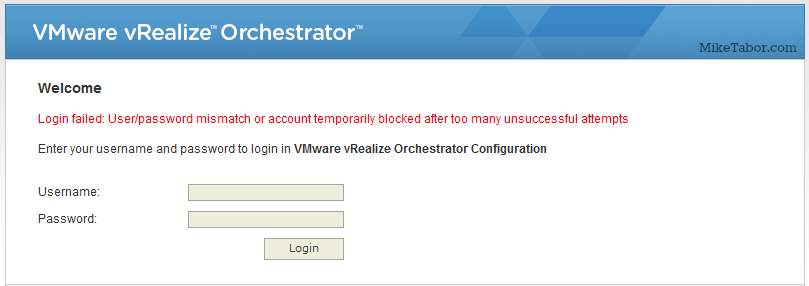
vrealize orchestrator account locked out

Earlier this month I posted how on how to fix the weak ephemeral Diffie-Hellman key issue in VMware vRealize Orchestrator 6.0.2 appliance. Another issue I’ve ran into is how to unlock vRealize Orchestrator default account. It seems you can lock the account after to many failed attempts but once locked the account does not seem to unlock… or at least for me after waiting more than a couple hours.

Luckily unlocking the vRealize Orchestrator default account is pretty straight forward.

Unlock vRealize Orchestrator default account

  1. SSH into your Orchestrator appliance, using PuTTy or similar application.
  2. Change to the /etc/vco/configuration/ directory:
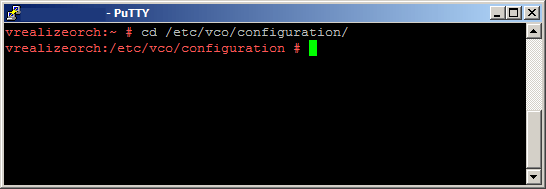
    vco configuration directory
  3. Edit the passwd.properties file using VI:
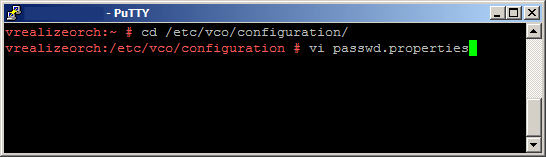
    vi properties
  4. Move the cursor down to the line starting with “vmware=…” and press DD to delete the line.
  5. Enter VI Insert mode by pressing i and paste the below code and then press ESC and ZZ to exit insert mode and save and exit VI:
    vmware=SHA512WithSalt\:GZ5wTW6Ni5x7\:wNCp8I8zHv7GQItrKDRjAgKsddjD4GUZ6nrOYhuEl3D+x4BT5Xs1KL8f/R2T3K2nYPzMwVTW9E9mmbvESAU3ww\=\=
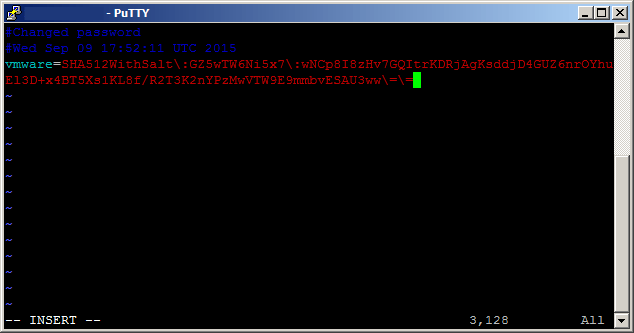
    vrealize orchestrator default password

  6. Finally restart the vRealize Orchestrator Configuration service

Once the service has been restarted you’ll be able to log into vRealize Orchestrator using vmware as both the username and password.
Similar Posts

  • Thank you VMware Community!

    VMware vExpert 2014

    So far, 2014 has been a very rewarding year for a number of reasons, two of which has happened in just a week or two span. First, Eric Siebert (@ericsiebert) announced on March 27th, this years results of the 2014 Top VMware & Virtualization Blog voting. My first year entered into voting and made it to 71st place! A huge thanks goes out to not only Eric but just as much so to everyone who voted for me!

    To top it off, yesterday VMware announced 2014’s first quarter VMware vExpert list. While vExpert isn’t a technical certification or even a general measure of VMware expertise. The VMware judges selected people who were engaged with their community and who had developed a substantial personal platform of influence in those communities. There were a lot of very smart, very accomplished people, even VCDXs, that weren’t named as vExpert this year. VMware awarded this title to 754 people this year and on that list of many impressive names you’ll find yours truly, Michael Tabor!

    I’m both honored and humbled by both lists. It’s a great feeling to be recognized by not only my peers through the voting in the Top vBlog but also by VMware themselves through the vExpert title.

    So again THANK YOU very much to the entire VMware community, a spectacular community indeed, and congratulations to everyone else that made the Top vBlog and vExpert lists!

  • How to install VMware vSphere Update Manager 5.5

    If you don’t already know, VMware Update Manager (aka, VUM) is a tool which allows you to easily automate patching and upgrading VMware hosts as well as virtual machine hardware and VMware tools. It’s a wonderful tool and makes upgrading and patching so much easier and allows you to quickly see how compliant/up-to-date your environment is with the built in pie graph.

    Recently we had some pretty serious array issues which corrupted the VUM database taking Update Manager down. Since we was going to have to rebuild Update Manager I opted to move from Windows Server 2008 to Windows Server 2012, in the steps below I’ll document step by step how to install VMware Update Manager 5.5 on Server 2012 and a separate database.

    Read More “How to install VMware vSphere Update Manager 5.5”

  • VMware vCenter 5.0 Update 1a released

    VMware vCenter 5.0 Update 1a has just been released and is the first major update since version 5.0.

    The main improvements being:

    • vCenter Server 5.0 Update 1a introduces support for the following vCenter Databases
      • Oracle 11g Enterprise Edition, Standard Edition, Standard ONE Edition Release 2 [11.2.0.3] – 64 bit
      • Oracle 11g Enterprise Edition, Standard Edition, Standard ONE Edition Release 2 [11.2.0.3] – 32 bit
    • vCenter Server Appliance Database Support: The DB2 express embedded database provided with the vCenter Server Appliance has been replaced with VMware vPostgres database. This decreases the appliance footprint and reduces the time to deploy vCenter Server further.

    Read More “VMware vCenter 5.0 Update 1a released”

  • How to update VMware ESXi 6.5 to 6.5 Update 1

    With the release of VMware vCenter 6.5 Update 1 also comes VMware ESXi 6.5 Update 1 and just like vCenter there are a number of changes, updates, and fixes for ESXi as well in 6.5 Update 1 – you can see the release notes here.

    Yesterday I made a post on how to upgrade VMware VCSA 6.5 to 6.5 Update 1. Below I’ll show you three ways to upgrade your ESXi hosts to 6.5 Update 1.

    Read More “How to update VMware ESXi 6.5 to 6.5 Update 1”

  • Upgrade ESXi host to ESXi 5.5 using VMware Update Manager 5.5

    A while back I wrote about how to upgrade to ESXi 5.5 via command line which works great when you only have a few hosts as each host has to download the ISO from the web each time. This time I’ll show you step by step how to upgrade your ESXi 5.1 host to ESXi 5.5 using VMware Update Manager 5.5 (aka VUM).

    For this post I’m going to assume you have already upgraded your vCenter and VUM to versions 5.5 as well as the VUM plugin installed. So lets begin!

    Upgrade ESXi host to 5.5 using VMware Update Manager (VUM)

    1. Open the vSphere client and click on Update Manager
      VMware Update Manager icon

    Read More “Upgrade ESXi host to ESXi 5.5 using VMware Update Manager 5.5”

  • My VMware View Windows 7 Optimization Guide

    These are the few steps I do when creating a new "Golden" image. Luckily I don’t have to do these steps all the time as I’ll create the "Golden" image when there is a new upgrade such as when we went from View 4.6 to View 5.0.1. I like to have a new fresh machine using new virtual hardware from the start. You could certainly just upgrade the virtual hardware on the "Golden" image, I just prefer to start clean.

    At any rate, here’s my list. Hopefully someone might find it somewhat useful and maybe even others can improve upon it.

    Preparing a new virtual machine

    1. Create New Virtual Machine – FILE > NEW > VIRTUAL MACHINE (CTRL+N)
    2. Under Configuration select CUSTOM.
    3. Select a Name, Folder, Host, Cluster, and Storage.
    4. Under Guest Operating System select Windows and then Windows 7 32bit under the Version drop down.
    5. Select which Network (VLAN) and under Adapter select VMXNET 3.
    6. Configure disk size to 30GB THIN provisioned.

    Read More “My VMware View Windows 7 Optimization Guide”

Leave a Reply

Your email address will not be published. Required fields are marked *