VMware vSphere 5.5 Update 2 released
vsphere 5.5 update2 released

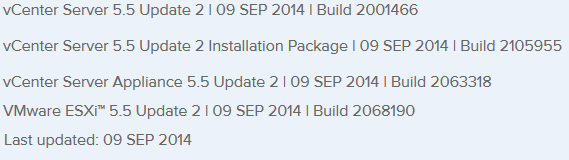
VMware vCenter Server and ESXi 5.5 Update 2 has just been released today with a number of fixes and additional features such as vCenter Server database support for Oracle 12c, Microsoft SQL Server 2012 Service Pack 1, and Microsoft SQL Server 2014 in vCenter Server and support for ESXi hosts with 6TB of RAM in the ESXi 5.5 update 2 release!

Resolved Issues

There are a number of resolved issues in 5.5 Update 2 for vCenter and ESXi, see the release notes for more details: vCenter Server 5.5 U2 & ESXi 5.5 U2 release notes.

One resolved issue I’m sure many people are going to be happy to see is this:

  • Unable to edit settings for virtual machines with hardware version 10 using the vSphere client
    When you attempt to perform the Edit Settings operation using the vSphere Client (C# Client) in a virtual machine with hardware version 10 (vmx-10), the attempt fails with the following error message:
    You cannot use the vSphere client to edit the settings of virtual machines of version 10 or higher. Use the vSphere Web Client to edit the settings of this virtual machine.

All you need it the updated vSphere 5.5 Update 2 client to enable this fix! This is GREAT, possibly the best news from the entire update! ;-)

Download the bits here.

Update ESXi host to 5.5 Update 2 via command line

Of course you could use VMware Update Manager (VUM) to upgrade your ESXi hosts to 5.5 Update 2 and this is typically the preferred way versus via command line one by one. That said if you only have a few hosts or don’t have VUM installed then you can also upgrade the hosts very easily via command line.

  1. SSH into your ESXi host.
  2. Open ESXi firewall to allow http requests.
    esxcli network firewall ruleset set -e true -r httpClient
  3. Then type the following command to download and upgrade to ESXi 5.5U2
    esxcli software profile update -d https://hostupdate.vmware.com/software/VUM/PRODUCTION/main/vmw-depot-index.xml -p ESXi-5.5.0-20140902001-standard
  4. When finished downloading and back to an input prompt – close the firewall to http requests:
    esxcli network firewall ruleset set -e false -r httpClient
  5. Finally reboot the ESXi host.
    reboot

Similar Posts

  • VMware vCenter 5.0 Update 1a released

    VMware vCenter 5.0 Update 1a has just been released and is the first major update since version 5.0.

    The main improvements being:

    • vCenter Server 5.0 Update 1a introduces support for the following vCenter Databases
      • Oracle 11g Enterprise Edition, Standard Edition, Standard ONE Edition Release 2 [11.2.0.3] – 64 bit
      • Oracle 11g Enterprise Edition, Standard Edition, Standard ONE Edition Release 2 [11.2.0.3] – 32 bit
    • vCenter Server Appliance Database Support: The DB2 express embedded database provided with the vCenter Server Appliance has been replaced with VMware vPostgres database. This decreases the appliance footprint and reduces the time to deploy vCenter Server further.

    Read More “VMware vCenter 5.0 Update 1a released”

  • VMware ESXi 5 fails to install on Intel NUC, “No Network Adapters” error

    If you use the VMware ESXi 5 ISO image and try to install it on an Intel NUC you’ll receive the following error during the install.

    No Network Adapters

    No network adapters were detected. Either no network adapters are physically connected to the system, or a suitable driver could not be located. A third party driver my be required.

    Ensure that there is at least one network adapter physically connected to the system before attempting installation. If the problem persists, consult the VMware Knowledge Base.

    The “No Network Adapters” on the Intel NUC error message during the ESXi install is because VMware removed a number of drivers (non-enterprise drivers) from their ESXi 5.x image and in order to use the Intel NUC as an ESXi host you need to create a customized ESXi image with the NIC drivers added to the image.

    Read More “VMware ESXi 5 fails to install on Intel NUC, “No Network Adapters” error”

  • Increase incremental backup speed by enabling CBT

    In a recent VMware environment I was working in, we noticed that our incremental backups was taking a long time (like up to 7-8 hours) to complete. After digging around it was found that VMware actually has a feature built-in since version 4 called Change Block Tracking (CBT). CBT will track any blocks that were changed since the last backup and tag them and stores the information in a -CTK file. The obvious benefit is that now the third party software only backs up the changed block and not the entire VM each time, reducing the amount of data being backed thus speeding up backups and even lowers the CPU utilization on the VM host.

    CBT is disabled by default though there are some backup tools that will enable it automatically or you can enable it manually which can easily be done following these steps:

    Read More “Increase incremental backup speed by enabling CBT”

  • Power off an unresponsive VM using ESXTOP

    Just recently we have some hardware issues in our primary datacenter and during that time had a few VM’s that became unresponsive and needed to get them back online. The VM’s had stopped responding to the normal vSphere commands to reboot, shutdown or even restart. I didn’t want to power cycle the entire ESXi host and instead just power off an unresponsive VM.

    Here is a quick and easy way to do just that using ESXTOP.

    Read More “Power off an unresponsive VM using ESXTOP”

  • VMware View client now availabe for Android!

    VMware has announced that they have released a View Client for Android tablets available on the Android Market now. Here are just a few of the features found on the new client.

    • A new look and feel – The View Client for Android features the NEW blue look and feel of the VMware View clients!
    • Multiple broker support – If you have more than one VMware View broker in your organization, you can can easily access your desktop from all of them via the Android client
    • Desktop Shortcuts – Quickly connect with as many as four recent desktop via shortcuts
    • Virtual trackpad – Control your desktop on a granular level just like you would control the mouse on a laptop
    • Custom keyboard toolbar – Super easy access to all of the special keys not found on the Android default keynboard
    • Honeycomb 3.x support – Made from the ground up for the new generation of Android tablets
    • Custom gestures – Invoke keyboard, scrolling, etc are as easy as ever and simple to use
    • VMware View Security Server support (best experience) – No need to have VPN when you use VMware View Security Server
    • Background tasking – Switch between apps on your tablet and come right back

Leave a Reply

Your email address will not be published. Required fields are marked *

3 Comments