How to update VMware ESXi 6.5 to 6.5 Update 1

With the release of VMware vCenter 6.5 Update 1 also comes VMware ESXi 6.5 Update 1 and just like vCenter there are a number of changes, updates, and fixes for ESXi as well in 6.5 Update 1 – you can see the release notes here.

Yesterday I made a post on how to upgrade VMware VCSA 6.5 to 6.5 Update 1. Below I’ll show you three ways to upgrade your ESXi hosts to 6.5 Update 1.

How to update ESXi 6.5 to 6.5 Update 1 via command line

If you’ve only have a couple ESXi hosts to upgrade, then using the command line method is a fast and easy way of doing so.

  1. Place the host you are upgrading into Maintenance Mode.
  2. Then SSH into the host using PuTTY (or any other SSH client/terminal).
  3. Type the following command to open the firewall for outgoing HTTP requests:
    esxcli network firewall ruleset set -e true -r httpClient
  4. Type the following command to download and upgrade to ESXi 6.5 U1
    esxcli software profile update -d https://hostupdate.vmware.com/software/VUM/PRODUCTION/main/vmw-depot-index.xml -p ESXi-6.5.0-20170702001-standard
  5. After the update has finished disable the HTTP firewall rule by typing:
    esxcli network firewall ruleset set -e false -r httpClient
  6. And finally, reboot the ESXi host to complete the upgrade.
    reboot
  7. Doesn’t hurt to also disable SSH when you’re done for security purposes.

How to update ESXi 6.5 to 6.5 Update 1 using an Offline Bundle

Using the offline bundle works similar in the way of the command line but saves you from having to download the upgrade bits for each VMware ESXi host. Great when you have more than just a couple hosts or limited bandwidth.

  1. Download the ESXi 6.5 Update 1 offline bundle zip file.
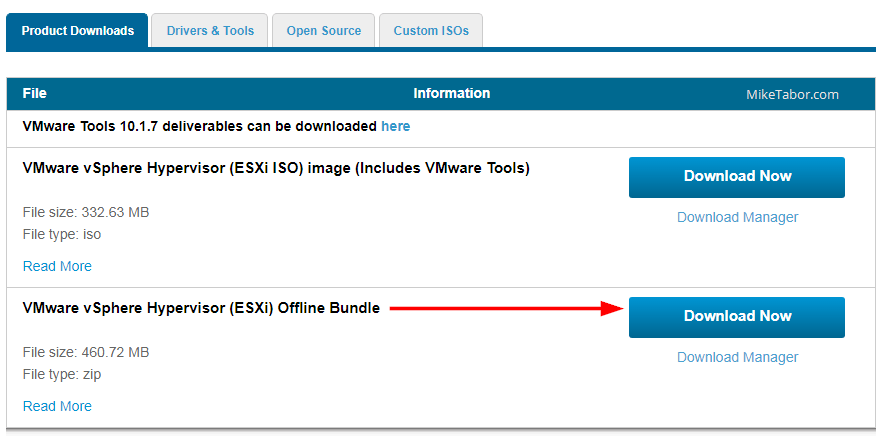
    ESXi 6.5 Update 1 offline bundle update
  2. Upload the update-from-esxi6.5-6.5_update01.zip file to a datastore accessible by the host.
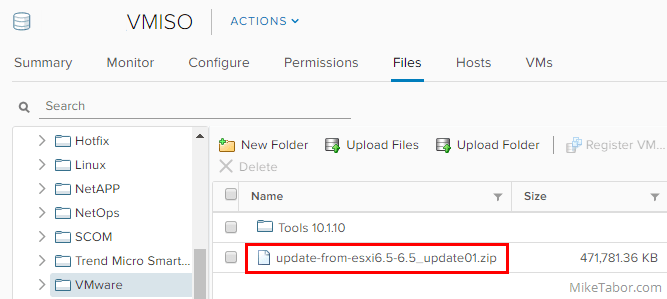
    ESXi 6.5 Update 1 datastore browser
  3. Now place the host you want to upgrade into Maintenance Mode.
  4. SSH into your host using PuTTY or other client/terminal.
  5. Type the following command, replace “DATASTORE” with the name of your datastore you uploaded the update-from-esxi6.5-6.5_update01.zip file to.
    esxcli software vib update -d /vmfs/volumes/DATASTORE/update-from-esxi6.5-6.5_update01.zip
  6. Once the above completes reboot your host by typing:
    reboot

How to upgrade ESXi 6.5 to 6.5 Update 1 with VMware Update Manager

If you have many ESXi hosts to upgrade and/or in an enterprise environment then using VMware Update Manager is probably the best way to upgrade your hosts.

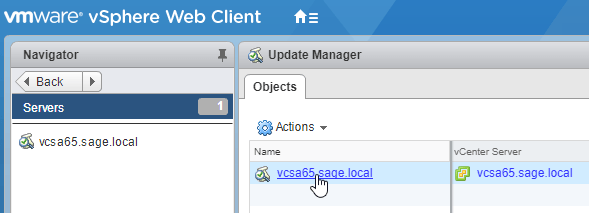
  1. Log into the vSphere web client and click on Update Manager.
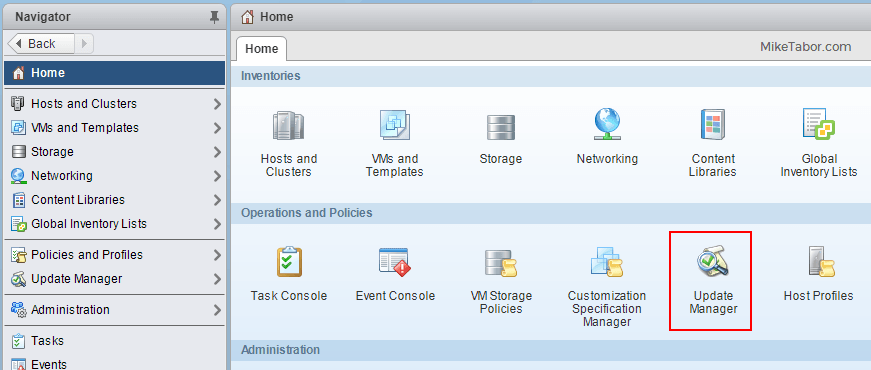
    VMware Update Manager
  2. Select the associated vCenter.
    Update Manager select vCenter
  3. Click on the Manage tab (A), then ESXi Images (B), click on Import ESXi image (C), and then browse (D) to where the download location of the ESXi 6.5 Update 1 ISO image.
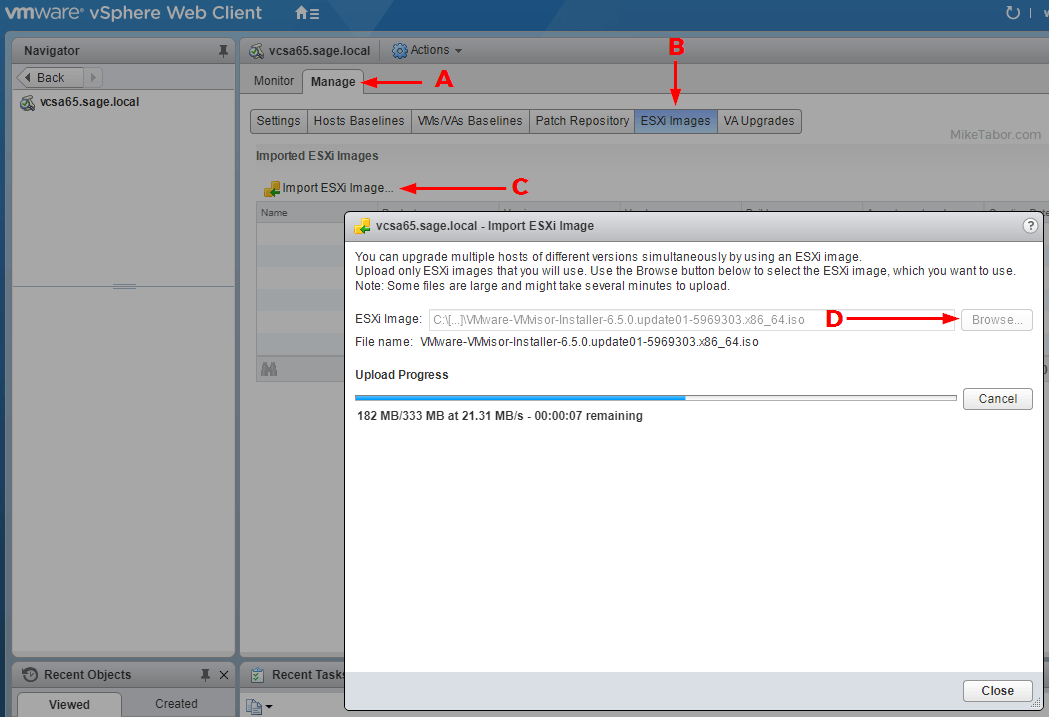
    VMware Update Manager import ESXi image
  4. Once the ISO finishes uploading, select the image and click on Create baseline.
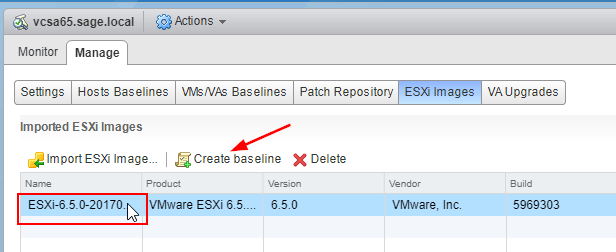
    Update Manager create baseline
  5. Give the new baseline a name then click on Ok.
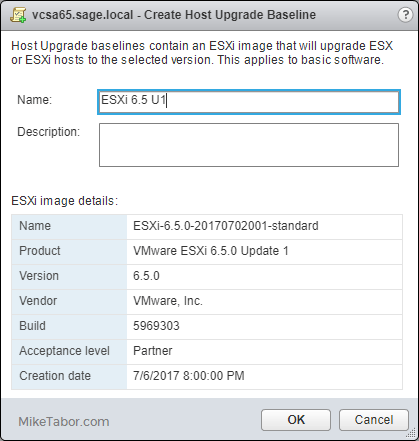
    Update Manager create host baseline
  6. Now we need to attach the new baseline to either a host, cluster or datacenter. In this case I’m attaching it to my cluster. Select your cluster, then the Update Manager tab and click on Attach Baseline…
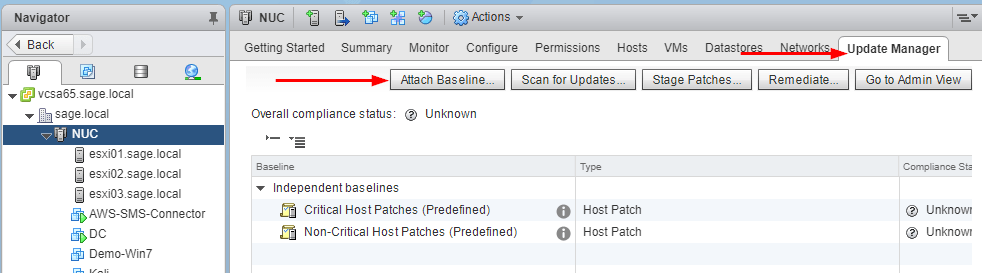
    Update Manager host view attach baseline
  7. Check the box next to the newly created baseline and click on OK.
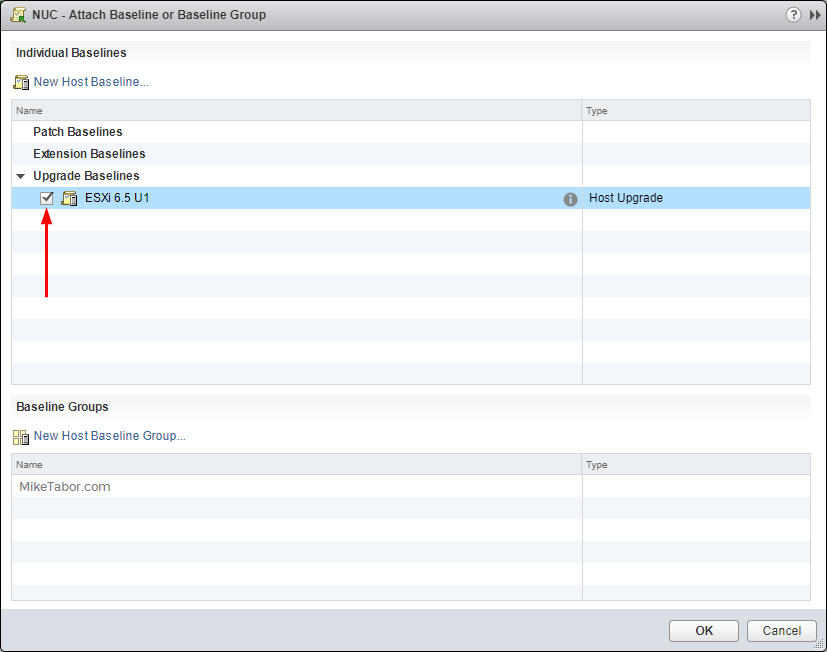
    Update Manager attach host baseline selection
  8. Next click on Scan for Updates… and check Upgrades and click on OK.
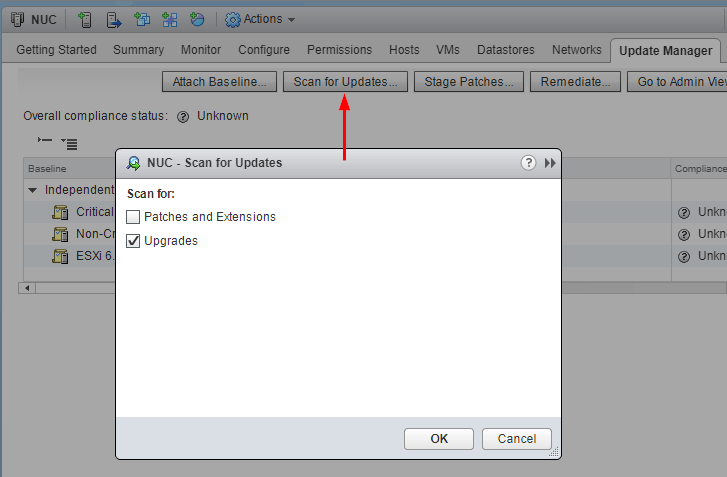
    Update Manager scan for updates
  9. Once the scan finishes, click on Remediate…
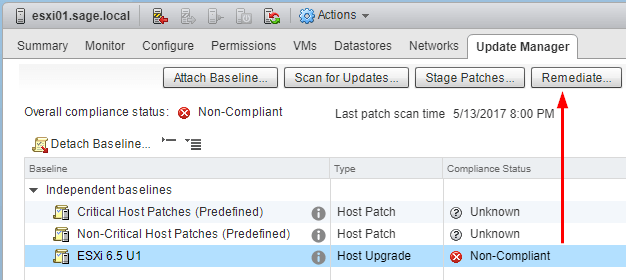
    Update Manager remediate
  10. Select Upgrade Baselines and your custom baseline and click on Next.
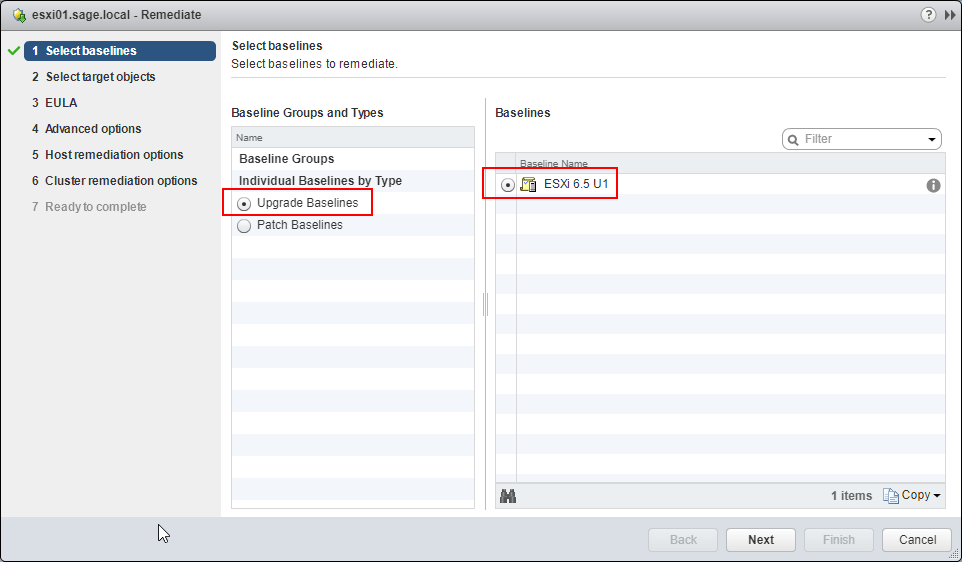
    Update Manager select baseline remediate
  11. Now select the host or hosts you want to have VMware Update Manager to update and click on Next.
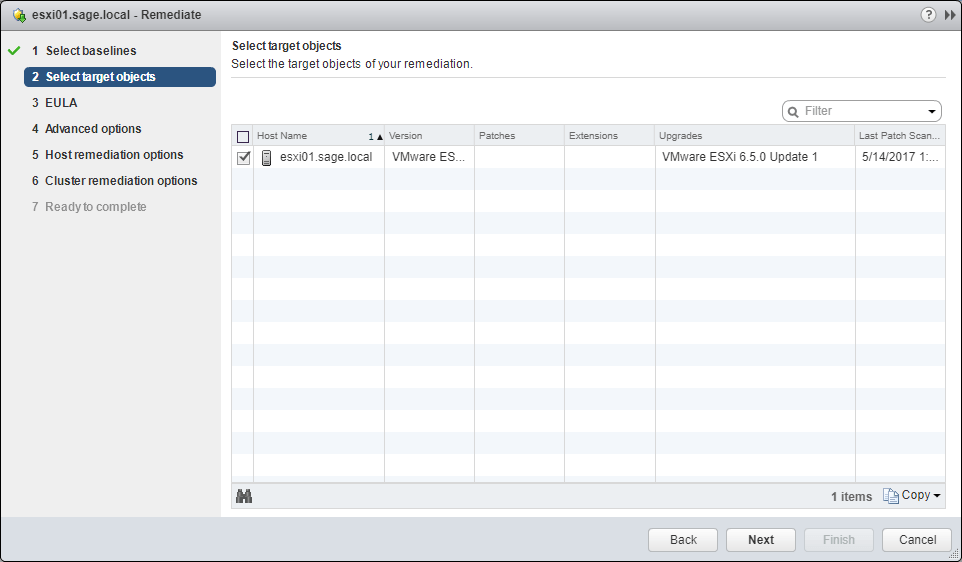
    Update Manager select targets
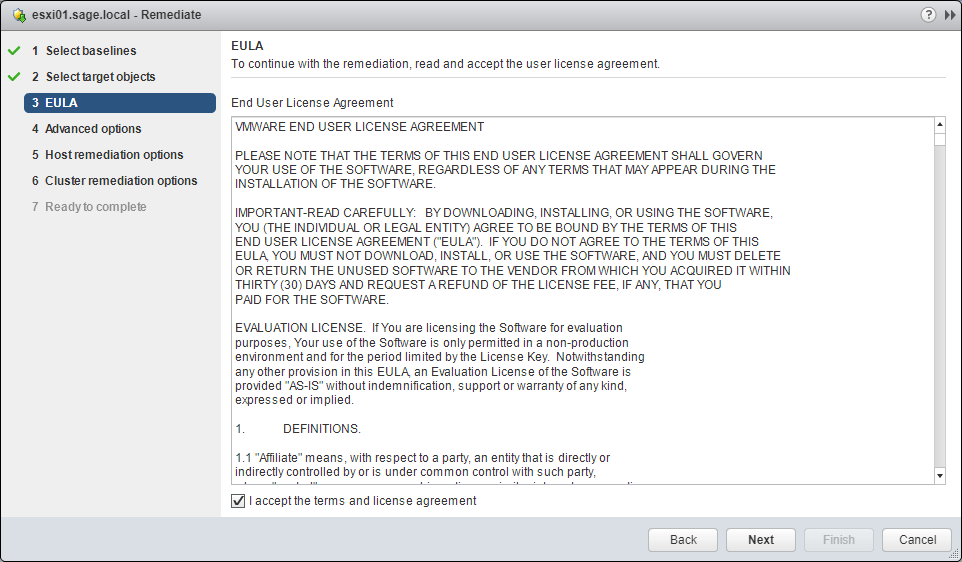
  12. Accept the EULA.
    Update Manager accept EULA
  13. The advanced options allow you to schedule the upgrade. In this case I’ll leave it unchecked to apply the update now.
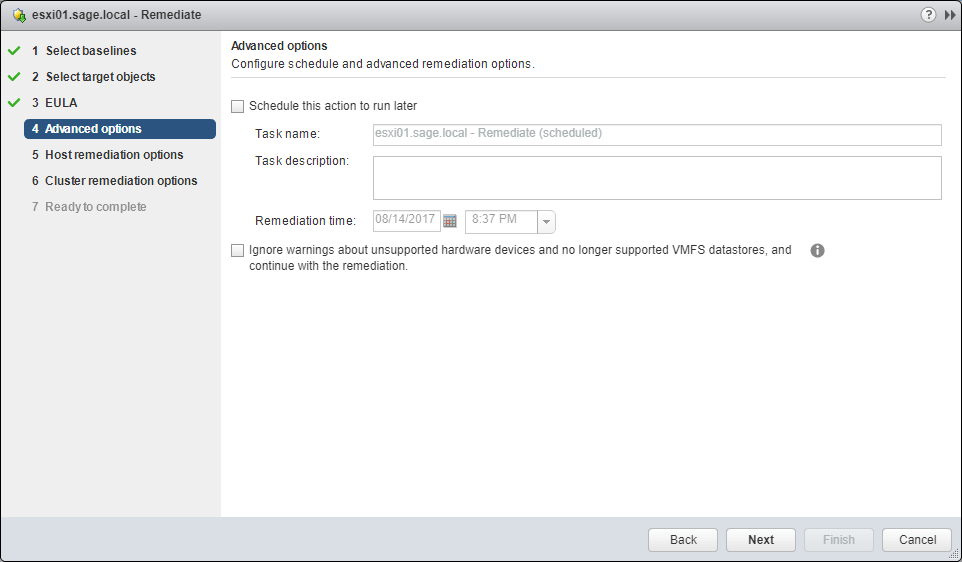
    Update Manager select schedule
  14. Set your host remediation options and click Next.
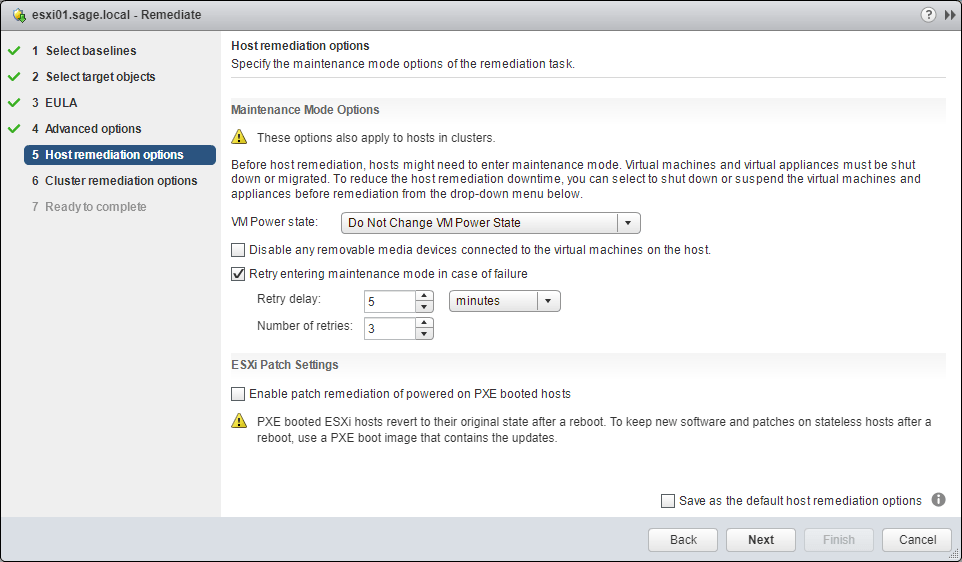
    Update Manager set host options
  15. Set cluster remediation options then click on Next.
    Update Manager set remediation options
  16. Finally, review the wizard and click on Finish.
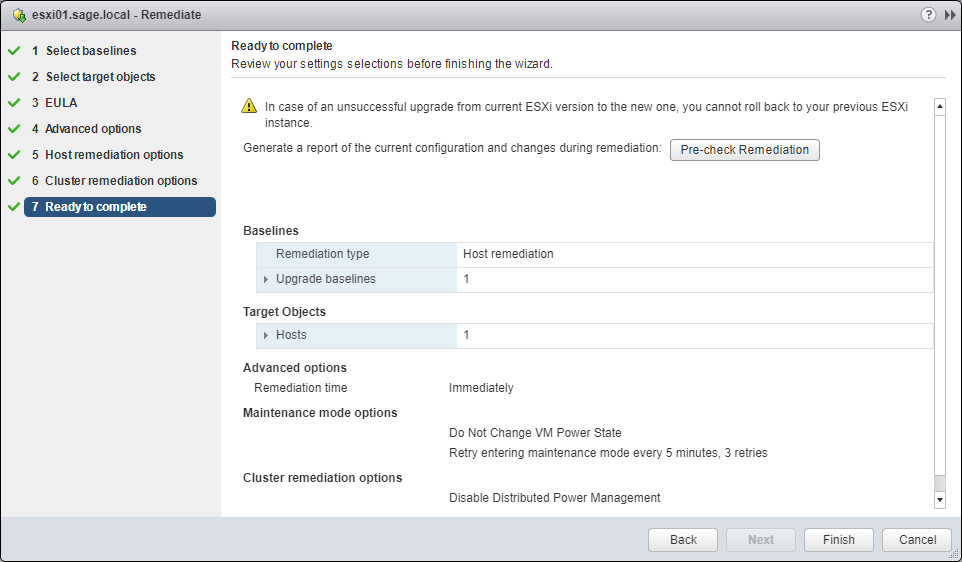
    Update Manager review and finish

At this point vCenter will migrate the VM’s on the host to another host (pending DRS is enabled on the cluster), place the host in maintenance mode automatically then upgrade the host, reboot it and then take it out of maintenance mode. If you’ve selected multiple host targets, it will then do the same to the next ESXI host after the first host is completed.
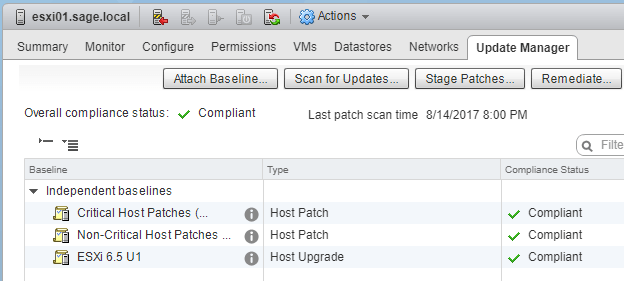
Update Manager host compliant

Similar Posts

  • VMware Recertification Policy

    VMware certified

    Starting today, March 10 2014, new VCP certifications must be re-certified within two years of it’s earned date. Anyone who currently has their VCP certification prior to March 10 2013 has until March 10, 2015 to re-certify.

    The new policy gives you three options to re-certify:

    1. Take the current exam for your existing VCP certification solution track. For example, if you are a VCP3, you could take the current VCP5-Data Center Virtualization (VCP5-DCV) exam.
    2. Earn a new VCP certification in a different solution track. For example, if you are a VCP-Cloud, you could recertify by earning VCP5-Desktop (VCP5-DT) certification.
    3. Advance to the next level by earning a VMware Certified Advanced Professional (VCAP) certification. For example, if you are a VCP5-DCV you could earn VCAP5-DCA certification.

    I can understand why they are doing this but I don’t agree with the changes. As per the announcement if you let your certification expire, “Your certification will be revoked,and you will no longer be entitled to use the certification logo or represent yourself as VMware certified“. Really? You mean everything that was done prior and after taking the exam means nothing?

    Read More “VMware Recertification Policy”

  • VMware Workstation updated to 9.0.2

    VMware is released a maintenance update for VMware Workstation to version 9.0.2. The update is available for free for all VMware Workstation 9.x customers.

    Mostly just bug fixes and a few improvements, here are a few highlights:

    • Fedora 18 supported as a guest operating system
    • Windows 8 host permissions issues fixed
    • VMware Tool updated to support the latest Linux kernels
    • Improved general host resource management
    • OVF Tool has been updated to version 3.0.2
    • Virtual machine sharing improvements
    • Memory leak which impacted Windows hosts has been fixed

    Read More “VMware Workstation updated to 9.0.2”

  • How to manually delete NetApp SnapMirror snapshots

    The other day, one of our volumes in the lab environment filled up. This volume has a couple large VM’s on it, coupled with a couple different Veeam backup jobs running using the native Veeam backup methods as well as using NetApp snap mirror to snapshot the volume and then using Veeam to ship it out to Azure.

    At any rate the volume filled up to the point where vCenter wasn’t allowing me to migrate VM’s off the datastore. I really didn’t want to expand the volume just so I could move VM’s off of it.

    Instead, I decided to delete some of the older proof of concept snapshots from SnapMirror. Below are the quick and easy steps to clear up some un-used snapshots and free up some space on the datastore.

    Read More “How to manually delete NetApp SnapMirror snapshots”

  • How to install VisualEsxtop

    If you haven’t already heard, VisualEsxtop is a Fling developed by a few VMware Engineers that provides a java based GUI to the every useful ESXTOP. As an added bonus provides a description of each counter, multiple windows, the ability to sort metrics, and even provide basic graphs. Oh and it’s FREE!

    Setup and install on Windows 7 is pretty easy as well:

    Visual ESXtop

    Read More “How to install VisualEsxtop”

  • VMware vCenter 5.0 Update 1a released

    VMware vCenter 5.0 Update 1a has just been released and is the first major update since version 5.0.

    The main improvements being:

    • vCenter Server 5.0 Update 1a introduces support for the following vCenter Databases
      • Oracle 11g Enterprise Edition, Standard Edition, Standard ONE Edition Release 2 [11.2.0.3] – 64 bit
      • Oracle 11g Enterprise Edition, Standard Edition, Standard ONE Edition Release 2 [11.2.0.3] – 32 bit
    • vCenter Server Appliance Database Support: The DB2 express embedded database provided with the vCenter Server Appliance has been replaced with VMware vPostgres database. This decreases the appliance footprint and reduces the time to deploy vCenter Server further.

    Read More “VMware vCenter 5.0 Update 1a released”

  • ESXi 5.5 free edition removes 32GB memory limit

    There have been a ton of exciting announcements coming out of VMword 2013, one of which is vSphere 5.5 and all of it’s improvements and additions. Along that note, VMware has changed ESXi 5.5 free version to remove the physical RAM limit which was limited to only 32GB in version 5.1.

    The new virtual hardware, version 10, we can now grow our home labs into more powerful VM’s as most all configuration maximums have been doubled:

    Read More “ESXi 5.5 free edition removes 32GB memory limit”

Leave a Reply

Your email address will not be published. Required fields are marked *

4 Comments

  1. Hi, which command i’ve to use to upgrade to latest build 6765664 using the path file ESXi650-201710001.zip uploaded on my datastore ?
    Thanks for help.. :)